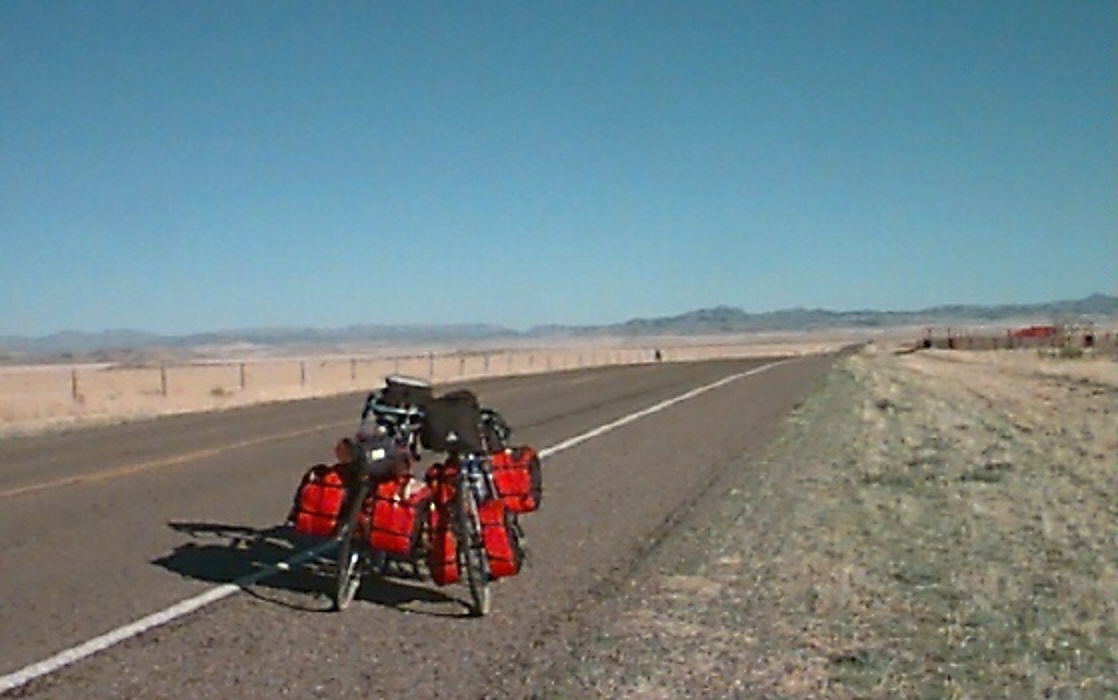
Still not entirely used to riding on the left-hand side of the road, I pulled out onto the wrong side of the road this morning as we left the campground. Good thing it was deserted. The morning's ride was tough but pretty, meandering through the foothills of the Kamai mountain range. I'd always imagined New Zealand to be full of sheep, but in this region cows appear to be the dominant species. Many of these animals were mysteriously penned up in the narrow shoulders of the roads and would freak out when they sensed us coming by on our unfamiliar steeds.
The deer-like Guernsey cows were especially skittish, stampeding at the least provocation. I would have been happy pumping through this idyllic car-free countryside all day, but it was not meant to be. After 25 kilometers or so we joined State Highway 3 at a narrow winding stretch, going straight up. The traffic was nightmarish; it was like being in Cyprus again. And the possum-paved road kept climbing and climbing. On the plus side, a sort of shoulder appeared as the ascent grew more gradual, and the moist forest closed in to provide welcome shade. Just as we thought we could handle climbing no more, the road leveled off and the forest opened up onto an eerie-looking volcanic plateau, littered with spiky lava outcroppings and mysterious mounds.
What ought to have been a delicious swoop down the other side of the mountains into Rotorua was mostly destroyed by road construction. Bumpy, loose gravel crunched under our tires and choked our lungs almost all the way into town. Our first impression of Rotorua was eloquently summed up by Fred as we rode into town: \"This is gross,\" he said somewhere between a used car lot, a mini golf course and a Burger King. It looked like the entrance into practically any medium-sized town in America. When we turned in towards the center, however, things began looking up. We rode past parks full of steaming geothermal activity, then along a surprisingly deserted lakefront into Rotorua's \"downtown\"
--essentially a giant parking lot with some buildings randomly thrown in for good measure. Lunch was in a trendoid café called \"Fat Dog,\" where the toilets are tastefully grafitti'd in multi-hued chalk with snippets of poetry and eco-musings. When I asked the server what the lasagna-esque blob in the glass case was, she looked at me with disdain and told me it was a burrito. I ordered it anyway; a mistake of course. Next item of business was to find a roof under which to sleep. Fred scored a deal at the tourist office, half price at an upscale motel on the shores of steaming, sulfur-smelling Lake Rotorua.
We are easily the youngest people staying here by about 40 years, and apparently the only ones who aren't part of an organized bus tour. Lots of permed old Korean ladies dwarfed by their omnipresent suitcases, or Helga and Hans from Krefeld, their eyes glazed over from too many days looking out the window of a bus. I feel like a victim of tourist hype in this shamelessly touristic town. It's like a Wisconsin Dells which takes itself too seriously. Nevertheless, the place does posses a certain charm. The pervasive stink kind of grows on you, and most of the locals are laid-back Maoris.
Shopping at nearby Pack 'n' Save we ran into nothing but Polynesians in every aisle (we didn't miss a one, since supermarkets often provide unexpected insights into alien cultures. Consider this: the frozen food section here is [inside]{.underline} a freezer). We thought we'd check out the town's pub scene --if one exists---but our energy levels and aching legs allowed for nothing beyond doing laundry and channel surfing in the sulfury cocoon of our hotel. It felt good to be back on the road and I am finally ready to admit that my legs weren't quite in the shape they were when we started.
Luckily we'd planned a tourism day here in Rotorua. The night before we'd purchased breakfast fixin's and slurped our way through breakfast in bed before venturing into daylight. We wandered into town after nine and arrived at our first tourist trap just in time for the really big show. The orchid garden sported a \"Water Organ\", sort of a dancing waters show. It was kind of funny for about the first five minutes. Lights changed colors, fountains swayed and spurted rhythmically, all to the tune of our favorite classics like Vivaldi's Four Seasons and the William Tell Overture -- not! We were really disappointed as we snuck out of the theater.
Had we gotten there earlier we could have made requests from their play list that included such classics as Feelings and Jail House Rock. The Orchid Garden itself was not even as interesting as the Water Organ. Very few stunning specimens were to be seen there. Our next stop was to be the Rotorua Museum. I was a little hesitant to pay the entry fee when I noted that they had a Bob Marley exposition in one of the galleries, but we paid the toll and entered the frigid museum. There they detailed the rich heritage of the Maoris, their skepticism for western religion and the paradise-like environment they lived in around Rotorua before the big events.
One advent was the appearance of European settlers and the second, perhaps more dramatic, was the explosion of the mountain above Rotorua. The flashes of the explosions were seen in Auckland some 200 kilometers away and the sound heard in Wellington three times that distance further. We read account after account of the horror by survivors and saw photos and other evidences of the victims. One was a mummified cat that was on display in a plexiglass case looking as though it was still uttering its last cry. One surprise at the museum is that they had the same lax standards of dress as the rest of New Zealand.
Seems almost one person in five doesn't even wear shoes. There were several museum patrons wandering around the exhibit nearly naked. Their attire seemed entirely appropriate in the exhibit entitled \"taking the cure\". There the Rotoruans chronicle the history of the healing power of the sulfurous steamy waters that run from the ground everywhere. The museum is housed in the old bathhouse for the community and for the exhibit they restored a few of the rooms and pools. Andy's favorite part of the exhibit was the photo of the famed electric bath. We both pondered how fabulous and tingly that would feel, eesh!
The next exhibit primed us for lunch. \"About trout\" was a simple collection of fishing trophies, photos of the catch of the day and flies. By the time we had walked through I was ready for a fishy repast. After lunch we'd planned to go to the Maori Village and Geothermal park. We started to wait for the shuttle bus, but took a taxi instead. Our well-traveled driver had spent four weeks in the States last summer. There she'd seen more of it than I ever had, travelling in a van with seven other Kiwis. She also gave us some insight into the problems brewing at the tourist attraction we were about to visit.
We'd been tipped off that there was some issue there by a seventy-year-old's letter to the editor in the paper the day before. He'd complained that he had to pay two entry fees to see the sights he'd paid only once to see before. The government had refused to \"cut\" the Maori village in on the entry fees so the villagers barricaded the entry and set up their own tourist trap. Against our Maori driver's recommendation, we decided on the government-run Geothermal Park and Cultural Center. There we knew we'd be treated to geysers, steaming pools, boiling mud puddles and a kiwi bird.
Between the noise of the park and the smell it was truly the only place on earth you could be flatuant without anyone being the wiser. All of this tourism in one day, but don't stop reading yet, because that evening we also attended a Maori version of a luau. We almost baled on it because the bus that was to pick us up seemed to have forgotten us and when we called they had lost our reservation. The desk clerk at our hotel convinced us that it was worth seeing, so we ordered a beer at the bar while waiting for our ride.
Shirley the bus driver came just as we had taken our first sip, she made an immediate bad impression on me when she asked that we pour them out before getting on her bus. After we made a stop at the office of the tour company to pay for our cultural experience an older Maori dude boarded the bus and began to brief us on the cultural protocol of the event to come. He selected a leader for our group, a reluctant dude named Ron. I listened intently waiting for the explanation of how and why the Maoris greet one another by rubbing noses.
Vastly disillusioned when I learned that only our leader would get to try out the nose rubbing with the leaders of the host Maoris. At our arrival we were greeted by an angry Maori who strutted, cried and made faces at us. His macho display was somehow diluted by the fact that he was a raging queen. Once we negotiated a truce with our hosts they invited us into their meetinghouse where they sang, danced and educated us before taking us to the holy mess tent. There we were served the most vile meal that had been steamed in the massive Maori outdoor oven, called a *hangi*.
Dinner's cast of characters included a brooding Israeli, a Brit and four trailer trash Americans. One named Lucky could barely speak he seemed so drunk. We finally made our way home in the bus through the rain while Shirley led us in a multi-national sing-along. Every imaginable bus song was wailed by all. Lucky tmade us sing \"Rocky Mountain High,\" in tribute to the recently dead John Denver. I longed to be finished with tourism and back on my bike.