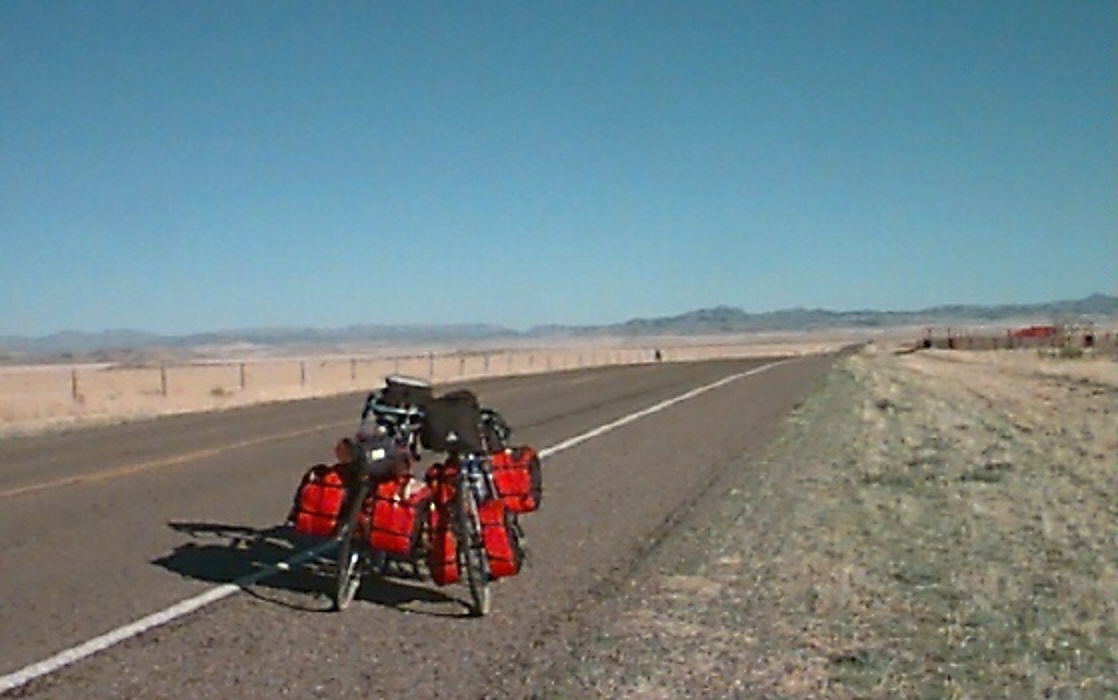
I didn't really expect much from Bharatpur. It was described in our guidebook as a flat piece of land that some raja or prince had flooded so birds would come and he could shoot them. In fact the terrain itself was as uninteresting as can be. Flat as a *dosa* (an Indian crepe, often stuffed and eaten as a snack or for breakfast) and covered with a grid of roads on dikes there was little to catch the eye in the bird and game reserve. As I began to ride through at sunset while Andy lay in bed I began to understand why people come to Bharatpur.
Bright blue kingfishers looked like Christmas ornaments on trees, similarly colored moor hens waddled around in the water and literally tens of thousands of storks nested and tended to their young. While I rode along a deserted path, herons and all types of water fowl flushed from the bushes as I passed, showing me the fanciful designs of their extended wings and tails as they escaped. Just as the sun was about to set over the golden marsh grass I startled a herd of spotted dear who sprinted off into the golden-red light on the horizon. Riding back at dusk I was joined by a legion of bird-watchers and photographers all riding in silence, apparently awed as I was by what they'd seen.
The next day I piled still-frail Andy into a cycle rickshaw to try and recreate my experience from the day before, but the sun did not cooperate, so we shivered in the gray morning mist as our Sikh guide pointed out bird after bird after bird. In the afternoon Andy found enough energy to join me on a quest to find the pythons that were supposed to live in the park. We found none; what we did find were a human species of snake. Some Indian kids intent on "befriending" us followed us around, loudly scaring off any bird or other animal we might find an interest in.
Beseeching them to leave us alone only made them more ardent. They kept demanding to see our camera which Andy interpreted as a thinly veiled attempt to steal it. I finally was so perturbed by them I asked them to leave us be, explaining that they were not the main attraction at the wild life preserve as hard as they may try. The next day we set off for Gangapur and Andy was more than a little grumpy. I suspect that it was because he was shooed away from the dining room before he finished his second cup of coffee. He had to vacate so that the well-heeled passengers of the Palace on Wheels could dine in privacy.
The Palace on Wheels is the upscale way to see India without discovering any of its discomfort. For three hundred a day (dollars not rupees) double occupancy they sleep and eat in the lap of luxury while their carriage is towed through Rajasthan from Delhi. They stop at some of the most fantastic spots and never meet a peasant because their legion of guides-cum-guards insulate them from all things *too* indigenous. Speaking of locals, some local malady was still invading my stomach and I was wondering if I might have to run out to a field with a little bucket of water to wash after relieving myself.
Both of us feeling grumpy led to a little bickering in the morning. Siegfried and Roy sensed the tension and acted up a little, trying to shed their panniers a few times before we actually managed to set off. I realized the profound difference between the Palace on Wheels passengers experience and ours as we loaded the bikes. They streamed off their ultra luxury bus into the care of their guides who'd arrived in advance in sparkling new Range Rovers. All were dressed in designer black and beige outfits except for the occasional tourist in safari wear. They stared at us as though we were freaks, stepping around us like we were dog droppings.
Koleodeo National Park had been a little oasis from India, insulated from traffic noises and surrounded by trees, wetlands and wildlife. Now as we passed the gates of the park and left this refuge we were decidedly back in India. The sad excuse for a road punished our butts, pummeled our hands and jarred my head and shoulders. Early in the day the rough road rattled Andy's bags from his bike. Though so bumpy and broken it was hard to turn my attention from the road there were a few distractions. Rajasthan is full of women so bejeweled it is a wonder that they can move with rings on their fingers, toes, ears and noses; bands on their wrists, arms, ankles.
If the women were something to behold we were beholden to the men of the region. At each stop we were besieged by dozens to hundreds crowding around us poking and prodding every part of us and our bikes. Crowds were so dense that it was nearly impossible for us to buy a bottle of water or a bunch of bananas. Most times we'd have to shout what we wanted over the heads of the hoards and have the goods passed to us. We'd send the money to pay through the hands of the crowd with little fear that it wouldn't make its destination.
Starting again was even more difficult. When we mounted our bikes the crowds stood motionless, gaping at our every move but seemingly unaware that we would actually like to leave. I tried everything from pantomiming that I was swimming through the crowd to finally just riding through without regard to anyone's health or safety. Andy aggressively bike-checked people he became so frustrated, which seemed to rile no one. Just when I thought the road could get no worse it became unbearable. Hundred meter stretches of sand covered the road. We'd approach the sandy bits, drop into our easiest gear, spin until our bikes swayed uncontrollably and fall over or dismount to trudge through the deep soft warm grains.
It felt like little doses of the Sahara, and it could be with all the camels passing us hauling huge carts stuffed with cargo. In stark contrast there were more humid barriers to travel. Each year during the dry season the rivers run dry until the monsoon when the raging rains swell them again. The monsoons are so fierce they wash away the bridges so instead they use Irish ones where small streams pass under the bridge but larger amounts of water run over the top. In these instances we'd have to shed our shoes and wade across carrying our bags and bikes.
Speaking of water hazards, each town is replete with them. Most houses have no running water so the women go to the wells that are roadside in the towns to pump water and lug it home. Excess water runs from the wells across the road where it combined with the traffic break the pavement into shreds leaving muddy rocky puddles in lieu of a road. The broken roads in towns make the suburban experience unbearable for me and asking the question "How can they live this way?" Because the road is not sealed each passing truck or car creates such a cloud of dust that everyone and everything in a village or town is coated with it.
If there happens to be any moisture, the road becomes a muddy slip'n'slide where each step or pedal becomes treacherous. Often the downtown area is a disgusting hybrid of the two where you choke on the dirty air while weaving your way around the dirtiest mud puddles full of water and animal feces. Throughout the day's ride I imagined the horror of falling into one of these cesspools and religiously avoided the dangerous bits of road, often weaving all over it in the process with my shoes carefully detached from my clips. Through one such region I heard a scream and a tremendous sloshing noise as Andy fell into a mud and cow-dung cocktail.
The noise was not unlike that of someone diving into a pool. Expletives streamed out of Andy's mouth. He'd lived out my worst nightmare. Now brown as any field worker only a little shinier and smellier Andy escaped the puddle, luckily without aspirating any of the muck. This was probably not the first time someone had fallen in the puddle. Almost immediately a good Samaritan appeared and offered to take us somewhere Andy could wash. He took us to a factory courtyard that was empty and showed him the hose. The courtyard was empty until we entered it. Then the workers streamed in to watch the excitement as Andy cleaned as much of the disgusting dirt off of himself as he could.
He was more than self-conscious as they intently discussed his every movement and gesture. Besides Andy's misfortune there were other distractions. The deeper we got into Rajasthan the more interesting the camels got. Their owners seemed very proud of them and perhaps more concerned with their appearance than their wives'. They apply henna and other dyes to their pelts to fashion designs. Many have had their manes died to resemble hair, or sometimes their faces are painted to look as though they have eyelashes, lipstick or mustaches. Almost all have at least bells that jingle loudly as they approach hauling their bulbous loads down the road.
The most prized ones have earrings and nose rings. Just as I was about to expire from our 128 kilometers of bone rattling road we arrived in Gangapur. We'd been told that Gangapur was "middle class" and that there were several "good" hotels there. Upon our arrival the locals could only direct us to one, the Raj. Near the very busy train station and upstairs from a pharmacy, it could hardly be classified as nice. The windowless room we were shown had never been cleaned. The bed was covered with rat shit and they weren't giving it away at 150 rupees.
I decided that we should try to train to the next town or find another hotel. After determining that neither solution was an option we paid the room boy to clean the room and went for dinner. On the way we joked about renaming the Hotel Raj to the Hotel Rat in honor of their hygiene problem. Despite the mess I slept peacefully on my own bedding.