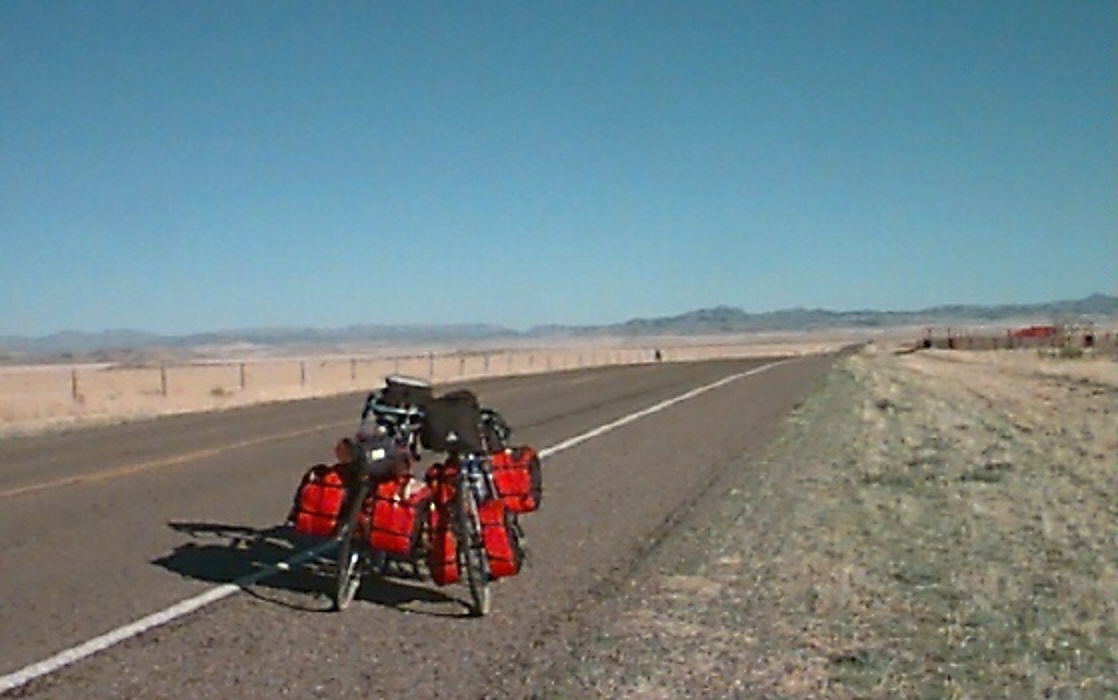
\"The Nile is Egypt and Egypt is the Nile\" Practically everyone we met told us this, incanting it like a mantra. \--That was ten years ago, during my first and only other trip to Egypt, which was really just a long weekend in and around Cairo. It seems that this ancient adage still applies however, even in an Egypt hundreds of miles from the Nile. Only ten kilometers of nasty Israeli coastline separated our beds in Eilat from the Egyptian border. Propelled by a killer tailwind, we were there in two shakes of a camel's tail. The exit process was precisely the same as the two that we had endured on our way to Jordan: lots of steps, lots of shekels to be dispensed, lots of suspicious, gun-toting teenage girls, lots of questions.
We met two Italians coming the other way on a motorcycle. They informed us that the road ahead would be hilly but nicely-graded (\"Yeah, if you've got 1000cc between your legs,\" I thought) and that the Egyptian authorities would demand a bribe, plus a lot of our time. It had cost them in excess of \$400 to bring their motorcycle in, they explained. Groaning, we headed toward the massive building comprising the Egyptian customs and immigration. While the Italians had been correct about the amount of time it would take, crossing the border didn't cost us a dime. We entered the vast, empty hall and wandered about aimlessly for a while.
The place was full of uniformed immigrations and customs inspectors, but they seemed to exist in another dimension, turning their heads away from us as we approached, and looking straight through us when we asked questions regarding the procedure. It was as if we were invisible. Only the money-changing guy seemed aware of our existence, when we started giving little kicks to the non-functioning ATM machine. \"There's another one at the Hilton,\" he informed us. He also pointed the way to the person in charge, a balding, rotund and self-important man who told us we couldn't obtain a visa for Egypt here.
\"You mean you won't let us across?\" He shook his head and told us we could enter the Sinai without an Egyptian visa. \"But I thought the Sinai was in Egypt,\" I said, to which he responded with a blank look. How would we get to Luxor? I wondered. \"You can get a visa in Eilat,\" the man told us. But neither the thought of riding against the wind nor having evidence of my visit to Israel appealed to me. Besides, at the Egyptian embassy in Aqaba they told us we'd be able to get visas at the border. When I asked if we could get one further down the road in Shar'm El Sheikh, he said he wasn't sure.
Reliable information was apparently a rare commodity in this country. Fred and I had a brief consultation on the subject and decided to push our luck. At the very worst, we could take the boat from Nuweiba to Aqaba, an absurd idea, but feasible. Or maybe this was just a sign that we weren't meant to go all the way to Luxor, I thought aloud, having no idea that the worst massacre in the country's history was occurring at that very moment, in precisely the place we had chosen as our destination. There were still many formalities to take care of, but we only discovered these when we unknowingly broke the rules.
The silent, laconic border guards, for instance, flew into a frenzy when we began pushing our bikes towards the exit. In irritated pantomime, they instructed us to put all of our possessions --including the bikes---through an x-ray machine. Somewhere during this process we encountered what appeared to be the only other traveler crossing into Egypt that day. A tall, skinny Brit, he was traveling on a moped, on his way to Eritrea and points east. Later, at Basata (where there are no secrets) we learned that this eccentric person was sponsored by Honda, and had already covered absurd amounts of distance on his little scooter.
Stopping to change money at the Taba Hilton \--constructed by the Israelis when they controlled the Sinai and just meters from the border---we ran into him again. He assumed we were stopping to spend the night, apparently having pegged us for the princessi that we are. No, I explained, we were pushing on, through the desert and hopefully to the Nile, to \"Egypt.\" Downtown Taba materialized only a couple of minutes' pedal further, and while it may not be the real Egypt, we definitely weren't in Kansas anymore. The village consists of a ramshackle collection of cement structures organized around a central \"square\"
filled with diseased-looking camels and randomly-strewn piles of garbage. It was already well past noon and we were hungry from all the strenuous immigration hassles, so we stopped at a gritty, fly-infested \"café.\" While a little brown boy assiduously attended to the task of grilling our chicken, we absorbed the ambiance. I thought how different this place was than Israel, and how we'd be spending the better part of the following year in the developing world. After an interminable wait, the chicken finally appeared, and it turned out to be as delicious as it was cheap. \"I could get used to this,\"
I thought to myself as we straddled our bikes once again, heading for the open road. Alas, one more bureaucratic hurdle remained before we could plunge into the rugged countryside. A scruffy-looking guy holding a gate said we had to pay a tax to leave Taba, forcing us to retreat to a filthy cubbyhole on the main square, where another unsavory character lurked, shaking us down for five bucks apiece. A few pushes of the pedals put Taba behind us. Multihued faces of rock rose above us on our right side, while on the right the azure Gulf of Aqaba glistened invitingly.
Parts of this pristine coastline were hideously marred by giant resorts under construction. I wondered who would ever fill these places up. Most Israelis would never consider vacationing in Sinai, and visitors from the rest of the world grow increasingly allergic to Egypt with each new terrorist attack. The whole thing smelt of a Mubarekian boondoggle. The supposedly flat road grew quite hilly. We played leapfrog with trucks for the rest of the day. They groaned slowly past us on the way up the steep slopes, and we'd scream by them on the way back down. Predictably, our tailwind had shifted 180 degrees, so even some of the downhills required straining.
And the picture-perfect day had given way to brewing storm clouds. The first big drops started falling just as we arrived at a place to stay on the beach, called Basata. From the road it looked like a godforsaken rathole, a random assembly of reed shacks on a rocky shingle. But for tonight it would have to do, the only shelter for miles around. A German woman --whom we took for the manager---showed us around the place while rattling off a long list of do's and dont's. Other guests were milling about the main \"building\", where rain was already pouring in through the reed roof, looking miserable in the gathering darkness.
Checking in at the same time as us were an odd trio of hippies: a young German girl called Verena; her Israeli admirer, Yaron; and a standoffish, head-in-the-clouds American trustafarian whom we called \"jingle belt\" for the string of bells she had tied around her bare midriff. We guessed correctly that they had met at the rainbow gathering up the road in Ein Yehov, and that Yaron had brought them here. \"It's the fifth hut down the beach, if you want to look at it,\" our hostess explained, noting that it might be a little wet inside, but that \"it never rains here, so it probably won't last.\"
Our other option was to pitch our tent on the beach, which I thought would be drier. Fred's idea was to set up the tent inside the hut, making me wonder if the ride through the desert had baked his brain. The hut itself was very simple indeed, just a bunch of reeds (obviously imported from an area of Egypt that had plants) tied loosely together and threatening to blow away in the increasingly blustery wind, a couple of mattresses without sheets, and a blanket for a door. No electricity, no running water, not even a window. I could feel Fred's dismay and promised we'd only spend a night here, and would reward ourselves the next day with a \"princess fix\"
at a glam resort. For want of activity and light, we headed back to the common hut and tried valiantly to play backgammon by the light of a single candle. Other guests --primarily brooding Israelis---lounged around and whispered conspiratorially, no doubt commenting on our inappropriateness. The place had the feeling of a meditation retreat, and we felt distinctly out of place. Dinner --served family-style at a long, low table\-- helped us break the ice a little. Miraculously some electric lights came on, and we warmed up to a German family through playing with their two-year-old, Phillipe. Then an Arab with dazzling green eyes and an infectious smile appeared, decked out in a jelaba and a kefiya.
His name was Sherif, whom we discovered the next day to be the owner of the place. Feeling a bit like intruders in an ashram, we slunk back to our hut not long after dinner, and sat in the damp, sand-blown darkness until beset by fatigue. We had every intention of pushing southwards the next day. I woke before sunrise and headed to the kitchen area for a do-it-yourself breakfast, competing with legions of flies. A couple of fresh-faced Americans were there with a much older chaperone. They said they were part of a program called \"semester at sea\", that their ship was docked in Port Said, and that they'd arrived in the middle of the night.
Steve, with a long white beard, was their geography professor, and it was from him that we learned of the previous day's events at Luxor. \"But that's where we're headed,\" I told him. \"You might want to reconsider,\" came his grave reply. Coupled with my persistent sinus troubles (no doubt acquired in dusty Petra), this news caused me to reconsider: maybe we should stay an extra day or two. It certainly was refreshing to have some other Americans around to talk to, and to break up the somber Teutonic atmosphere of the place. When Fred showed up, I instructed him that we were staying an extra day, which didn't seem to bother him at all.
It turned out to be a fantastic day, too. The snorkeling was superb; we yoga'd on the beach with a couple of the young boat people (including the tall and charming Andy, for whom Fred fell like a stone in water); I dozed on our hut's verandah, and soon it was time for dinner. The staff had seen fit to stick all of the Americans together, and our loud talk drowned out even the Israelis. I couldn't remember the last time we'd been able to speak pure and unfettered American, and their exuberance, their irreverence and lack of pretense was like finding water in the desert --I couldn't get enough of it.
They told us of their previous adventures in places like China and India, as well as the vicissitudes of life at sea with a few hundred hormonally-charged students. Two days later, the Americans all had to be back on board their ship, yet we remained at Basata. The place had grown on us, and the unaccustomed rest felt heavenly. Each passing day melted serenely into the next. We'd contemplate leaving every morning, then push our departure off until the afternoon, or the next day, or perhaps the day after that. A big part of what made us want to stay at Basata was the people we met there.
Yaron, whom we steered clear of at first, fearing him overtalkative, revealed himself to be a charming and erudite fellow. He spoke a half dozen languages perfectly, and maintained a consistently positive attitude towards everything. Verena turned out to be pretty tolerable, too, in love with San Francisco and things American, while Jinglebelt remained curiously aloof, perhaps wanting to avoid her compatriots. After the American group left, we finally made inroads with the mysterious homo Egyptian couple, Yusef and Mahmoud. Yusef was from a wealthy Cairo family, yet even his fellow countrymen assume he's an outsider for his pink skin and yellow hair.
Not quite albino, Yusef bears an astonishing resemblance to Harpo Marx, though he's far more articulate and cultivated. He has been involved with Mahmoud for over two years, but the two have yet to consummate their love for one another. Yusef says he doesn't want to press his handsome Nubian beloved into anything he didn't want to do. The whole arrangement reminded me of \"Ballad of the Sad Café.\" When Yusef and Mahmoud invited us to join them on an excursion to Nuweiba to buy duty-free booze and swim with a tame dolphin, we agreed instantly. Not only would we get to see Nuweiba's dubious (and much-discussed at Basata) tourist attraction, we'd also hopefully get a better glimpse into the weird workings of our Egyptian friends' relationship.
Besides, it was Fred's birthday, and maybe the duty-free shop would have champagne. After several delays, we all piled into Yusef's bright yellow car (to match his hair?) and headed southward. Mahmoud was at the wheel, swerving randomly from one lane to the other, at varying speeds. Fred and I kept looking at each other, silently praying that Yusef would drive on the way back. Up to that point, it was the longest and tensest 23 kilometers I'd ever experienced in a car. The duty-free shop was an ordeal, overseen by several fat bureaucrats who had a scam going wherein they only let you buy three of the alotted four bottles per person, so they could sneak the last one out and sell it on the black market.
Our passports were perused --and even stamped---several times, and it took forever to calculate the bill. Yusef, indecisive on the bottles he wanted us to get for him, only complicated matters --his modus operendi, it quickly became clear. In the end, what ought to have taken five minutes used up the better part of an hour, but everyone walked away satisfied. Not so at the dolphin beach, where Fred said he'd rather watch from land while we went swimming, at two bucks a head. The Bedouin selling tickets insisted that Fred pay as well, which sent Yusef into a frenzy. \"Would you have this man pay to look at the sun, the sky, things made by God?\"
he asked, spitting lots more high-volume hyperbole in Arabic, and nearly coming to blows with the flustered ticket-seller. As the famous dolphin rolled languidly in the surf, Yusef drove us away in a huff, the rest of us laughing at the overly dramatic episode. Yes, Yusef was behind the wheel now, causing me to revise my opinion of Mahmoud as the worst driver in Egypt. Yusef is quite simply the worst driver in the [world]{.underline}. The road that led us to lunch was only a couple of kilometers long, but it took forever and was as much a white-knuckled ride as anything at Disneyland.
He drove along at walking speed, sometimes slower, carrying on a conversation with us with us in the back seat, looking straight at us. We kept having to tell him to steer left or right in order to avoid careening into a ditch, another car, or a camel. Lunch was another interminable affair, full of confusion and torpor on the service side. We drank some of the warm beers purchased duty-free, watched an adorable little boy play with a knife and then climb aboard a camel dozens of times his size, and waited for our food to appear. Afterwards, we made a shopping stop in a gritty tourist strip, where Mahmoud bought something or other while Yusef flirted shamelessly with a young Bedouin selling tacky souvenirs.
\"Now let's go find some marijuana,\" announced Yusef, saying that he knew a Bedouin at a beach hotel who might have some. He drove through the parking lot and onto the beach to get to the place, causing some commotion among the staff. Fred wisely chose this moment to go for a walk on the beach while Mahmoud and I stood sheepishly beside Yusef, ranting on in Arabic. Again, we piled into the car, and, miraculously, our driver and host found his way to the road. His driving technique remained unchanged, and here on the highway passing trucks would lay on their horns in protest; but Yusef remained oblivious.
At one point he was looking at the cliffs to our left, indicating them with both hands to Mahmoud and then stopping the car in the absolute center of the road. Fred looked at me, panic-stricken, and said, \"IDWD,\" meaning \"I don't wanna die.\" Moving again, he swerved without warning to the left, stopping in front of a concrete bunker-like structure advertising \"Camel Turst.\" Thinking it the ideal place to purchase some weed, he entered and asked around while the rest of us stayed near the car. Sure enough, a Bedouin guy popped out of the desert and provided Yusef with what he wanted.
With about a thirty minute wait, it was by far the quickest transaction of the day. By some miracle we made it back to Basata in one piece. It was already getting dark. After hurriedly thanking our hosts, we hightailed it back to our shack for a little respite before dinner. Of course we'd have to stay another day now, if only to recover from the drive back from Nuweiba. Fred's birthday was a success. We shared our two bottles of champagne with everyone at dinner, and the cook had baked a huge, delicious cake. Yusef provided further party treats, which were enjoyed while sitting in a beached boat, looking up at the stars and listening to Mahmoud's fluid voice singing Nubian love songs.
We met plenty of other people, too. Like the divorced and forty-ish Lindsay from England, there for six months on a sort of spiritual quest. Marianne was Danish and also divorced, after many years living in California with her American husband. Rounding out the trio of single ladies was a tall German woman with remarkable poise, visiting from Lucknow, India, where she has lived for many years on an ashram. Another German, York, was there with his hilarious Japanese fiancee, Kao-li. They met in Berkeley but were now living in Cairo, where York was studying Egyptian politics. We never did figure out the story of Dr.
Ethan and his close friend, two older Israeli men who both had wives back in Tel Aviv, yet remained curiously intimate with each other. Then there were the French: adorable Alain was actually half-Egyptian, living in Cairo, disappointing Fred terribly when he began expressing an interest in the two German girls who manage Basata, Katherine and Caroline. Dodic and Daniele were a pair of older women from St. Malo, and had arrived directly from Luxor, where they had visited the \"temple of blood\" the day after the massacre. \"It was great,\" spouted Daniele, \"we had the whole place to ourselves. You should go too, you silly scared American.
I mean, we've all gotta die someday.\" I told her that I'd prefer my death to be something other than being splattered over ancient columns and cut open like a fish, but she had planted a seed in my brain. Why couldn't we continue on to Luxor? Our family would kill us of course, but they didn't have to know. Just when things had achieved a sort of stasis at Basata, falling comfortably into a slow, languid routine, Borg Hornemann showed up, right in the middle of dinner. Everyone was sitting crosslegged at the their respective tables, carrying on hushed conversations, when a man looking amazingly like Santa Claus (only wearing far fewer clothes) strode in and announced in his booming Danish voice: \"Hello, everyone, I am Hornyman.\"
The guy was out of control, a font of useless information that he wasn't shy to share with you. But you couldn't help but admire his enthusiasm towards practically everything and everyone. You came across him everywhere --on the way to the shower, out snorkeling on the reef, up on the hill people climbed to watch the sunset--- and once you engaged in conversation (more like a monologue, actually), he had you trapped there for at least forty-five minutes. It was tempting to stay on at Basata, but our bikes were beginning to look lonely all by themselves. After six nights in this magical place, we decided definitively to hit the road south, to Dahab, famous for hippies, diving and dope.