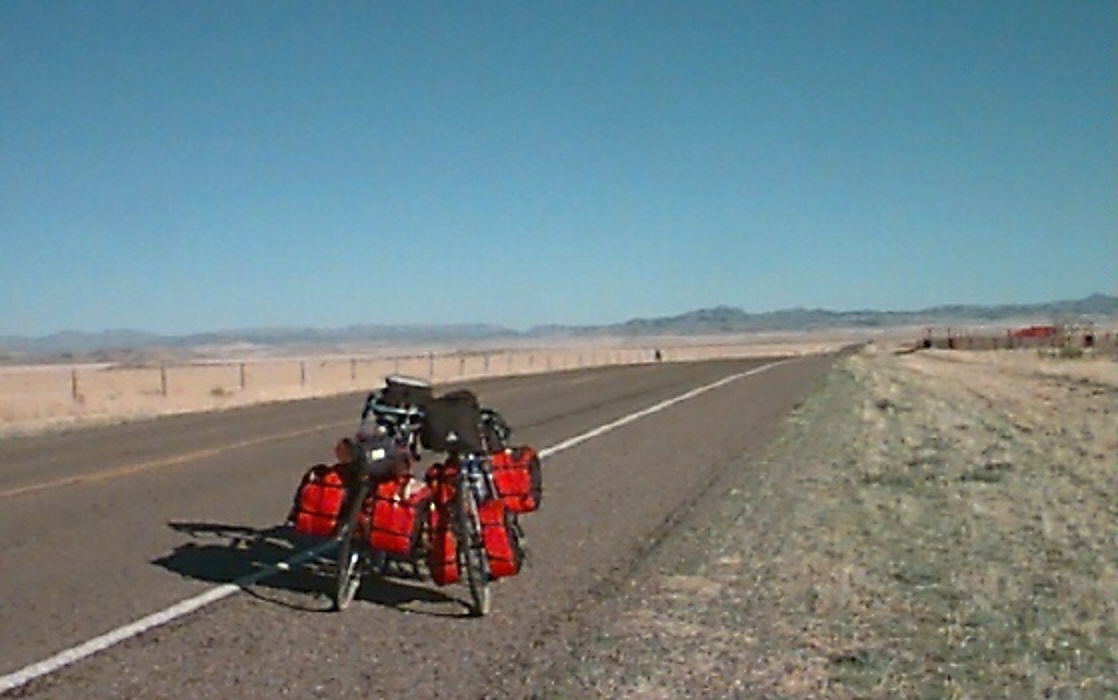
My legs felt strangely weak and rubbery beneath me as we pedaled out of Fardapur towards our next cavey destination. Was I out of sorts? Or was the end of the trip so near that I was running out of energy and motivation? It could have been that the cycling was more challenging then what I'd become accustomed to. The first forty-five minutes of the ride went straight up a *ghat* (ridge or mountain range). It had been ages since we'd climbed more than a few hundred meters in a day. At the end of today's ride we had racked up nearly a thousand, riding along the upper reaches of the ridge, rolling up and down through fields of cane.
There were some great moments riding. At one point as we passed a peasant driving an oxcart loaded with sugar cane. The driver flagged us down in order to cut chunks of his sweet juicy harvest for us to chew on. I bungied the excess on the back of my bike and shared it with some appreciative school children we met further down the road. Often the last kilometers of the day take the most effort. Beaten by the exertion of the day they drag off into infinity and make it seem as though will never make our destination. Not today; we whizzed down the last hill reaching speeds of over fifty kilometers and hour passing traffic on the way.
Though tired and achy after our ride I couldn't pass up the opportunity to explore the caves. The caves here in Ellora were reported to be even more fantastic then those of the day before in Ajanta. Ellora's caves have few surviving paintings but the carvings inside the caves are far more intricate than Ajanta. In Ellora there are three types of shrines. The oldest are Buddhist, middle Hindu and most recent Jain. We decided to attack the caves starting with the oldest first. Each of the first eight caves housed an inner shrine with a seated Buddha (*viharas)*. Some of the later caves sported an inner shine whose walls were a collage of hundreds or thousands of carved seated Buddha images surrounding the massive Buddha image.
The latest cave of this series was completely different. Its hall was not square, but was carved in like an oblong baroque chapel with stone pillars supporting a raised all carved within the cliff. Instead of featuring an image of Buddha this one enclosed a crowned sphere like those found at Ajanta. The next series of caves (Hindu) had uninteresting exteriors. I likened them to office buildings with square cut windows on three levels looking all-too-boring and symmetric. Inside they were far from boring. Each gallery on every level was carved with the stories of the trials and triumphs of the Hindu gods.
We could have spent hours in each temple, but we were anxious to see the most impressive of all the temples here and perhaps elsewhere. The last of the day was number 16. When work began on "cave" (not really a cave at all) number 16 carving, simple caves out of the cliff was no longer a challenge to the Hindus, a more ambitious project what the gods ordered. There they carved a freestanding temple out one piece of solid rock. The edifice-cum-sculpture stands 40 meters high, one hundred meters deep and 40 meters wide, making it the largest monolithic sculpture on Earth.
Full-scale elephants guard the rear and huge tigers race around a disk atop the temple. Every other surface, interior and exterior, is carved with animals, gods, the kama sutra and anything else that captivated the designers' imagination. It is said that it took 70,000 workers one hundred and twenty years to complete the carving. I have never seen anything like it before and expect to see nothing like it again. As the sun began to set we hiked along what remains of the cliff above it and watched the red light reflect on the rock carved tigers below. Hiking down and out of the park we ran into some disgruntled Australians.
They'd planned to enter the park with their *didgeridos* (a long tubular instrument used by aboriginal Australians, make a weird other-worldly noise that sounds like the noise a spring makes in a cartoon. *Didgeridon't be in our dictionary, so help us out if you know how it is spelled*) Thankfully the park guards prohibited them from entering with their instruments, sparing us their noise and delivering us a peaceful day at the caves. I was curious why someone would travel with a *do* so I asked them about it. Naively I thought the instrument would be heavy and ungainly. The *dos* I'd seen before were constructed out of wood.
"No, its much more practical these days. In fact, you can buy them here in India constructed out of light bamboo. And the sound is the same!," he replied excitedly. "Or, you can even have one made out of PVC, very practical for travel." I was unconvinced of the practicality or interest in of hauling a six-foot stretch of water pipe on my vacation but I admired their enthusiasm all the same. The next day we were tourists once again. We visited a sacred lake where Shiva is said to reside at night. Those who take a dip in it are sure to find a place in the heavens, have all their ails cured and problems solved.
I thought about diving in and living a life of bliss, but couldn't deal with the immediate problem of how ill one might become swimming in the putrid waters. And if this was such a holy place why had dogs, monkeys and humans defecated all over the rim of the stone stepped lake? Later we stepped into a temple where it is said that Shiva's consort Parvati rubbed red pigment onto her hand. Fire leapt from the powder and the fire was installed in the rock of the shrine. This temple is one of the twelve "self-orienting" temples in India. We still have no idea what "self-orienting"
means but we do know that we had to take off our shirts and shoes in order to enter the sacred shrine. At lunch we met an Indian/American couple. They'd been traveling in the south visiting their Indian family. Arvind is Indian and works for Monsanto in America. There he'd met his wife yyyy, fallen in love and married. Now that they'd been married for over a year they were visiting India to meet his family for the first time. She was wearing a baby blue sari looking Indian in every way except for her skin color and her bright white tennis shoes.
We rode out to the Jain cave/temples in their hired Ambassador with them and explored the site together. Arvind and yyyy had to catch a plane to Udaipur (where they later told us Arvin had been treated like her manservant) and left us to explore on our own. Andy went back to see the earlier temples once again while I decided to hike to see the sacred bathing spot of Sita. Sita's sacred bathing spot is a series of rock pools fed by a brook all above the cliff-carved temples. I followed the babbling brook several kilometers passing water-worn temples to Shiva, cows and no other tourists.
Opting to take another route home as the sun began to set I began to regret being alone and that I wasn't wearing long pants. I got lost in the thick underbrush trying to cross a ravine in order to return to the road and back to our hotel. I arrived at temple 16 as the sun dipped below the horizon and hiked back to the hotel in time to share a twilight beer with Andy as darkness fell over Ellora. After our cocktail I went to the office of our hotel to ask the manager a question. There I met Carmel.
She'd been here in India for thirty years and was an expert on the caves. We dined with her. She told us of her experiences in India and about her books. Feeling oddly out of touch with America, our culture and society she asked us how she as an American should deal with various familial situations. I felt a little awkward giving advice to someone so obviously more experienced than me. I would have felt more at home if she'd offered me advice.