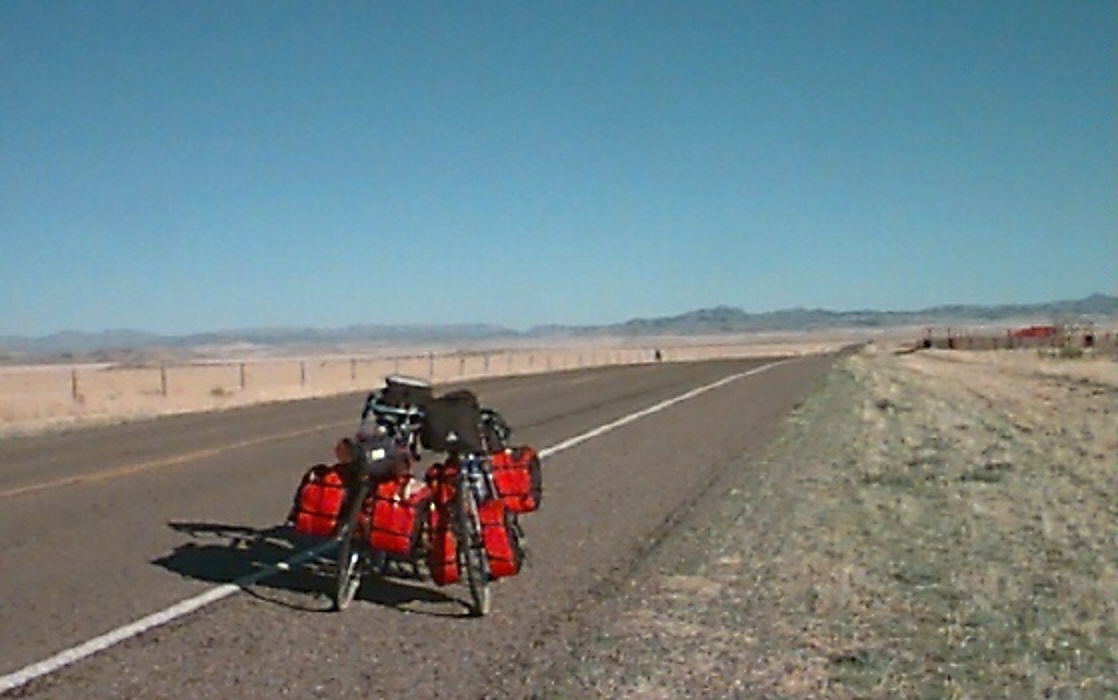
Saturday's bike ride was more ambitious, and by the grace of God, the weather cooperated. It was clear and crisp as we set off, first to breakfast at a competing state-run hotel called La Ermita (the boycott of Trufina was on), then on past the Mural Prehistorico, though Cuba's pristine countryside. We climbed and dipped through a lush valley full of tobacco fields and tall trees. After 20 miles we hit our first town --Pons---where we caused a sensation at the guara stand. Guara is pure, freshly-squeezed sugarcane juice and a supposed energy booster. A fellow patron said we'd be needing it, too, since the road to Santa Lucia was hilly.
And he wasn't kidding. Fred said the road must have been designed by Puerto Ricans, for it twisted up and down in search of the highest and lowest points, just like the road we took over the mountains in Puerto Rico a year before. Soon we were pedaling through pine forests. During a roadside stop another Cuban racer zoomed by, sporting all the fanciest cycling duds. Then a rather inbred-looking peasant cruised by on his oxsled, which scraped noisily against the asphalt. The only other vehicles we noticed were an unlikely-looking taxi parked in front of a shack and a broken-down truck.
It was blazingly hot when we rolled into Santa Lucia just before noon. The town was ugly and poor, an old mining center gone to hell. The town's only restaurant wasn't open yet, but a local youth said he knew of a place for refreshments. He led us on foot through a ridiculously long labyrinth of increasingly scruffy lanes. Fred cracked at about the tenth time the guy said \"only a hundred meters more,\" whereupon we jumped back on our bikes and rode back to the town center for palettas --frozen treats on a stick. The coastal road back to Vinales was boring, long and in piteously bad shape.
We also had to fight an evil headwind and a blisteringly hot sun. Just as we had run out of water, at about mile 50, a mirage appeared as we rounded a bend: a glistening gas station in the middle of nowhere. Yes, they had a dollar shop, too, where we gleefully dropped four Yankee greenbacks on water, a coke and various sweet and salty American agouti snacks --all in a sanitized, overairconditioned environment. We met a Cuban-American here who was cruising his native land in a flashy rented Hyundai. The locals, meanwhile, drooled over our bikes and mysteriously carried gasoline away in little plastic bags.
From here the scenery turned awesome again as we reentered the land of mogotes. On the climb back up towards the Cueva del Indio we stopped to chat with a geeky Swiss dude who had just begun his cycle tour of the island on a Flying Pigeon that he had purchased in Vinales for \$40. He said he planned to stay in people's houses, since you \"couldn't bring a girl back to your room in a hotel.\" Fred and I pronounced him officially brain-damaged and continued our climb. In Vinales we stopped at Dago's again for beers and Cuban pizza (it was a rather greasy concoction, and we made the unfortunate choice of ordering it with ham).
The place was hopping. Dago was obviously drunk, wearing a Che Guevara tee shirt and dancing with Italian tourist ladies to the three-piece combo who probably weren't working for the state (nor for pesos, for that matter). Enrique, our cycling friend from two days before, cruised by in the street and we invited him to join us for beers. We talked politics. His view of America was that it was a dangerous place full of criminals and homeless people who couldn't get health care. His wife, on the other hand, had just delivered a baby in the state capital free of charge, and his baby would be able to attend free schools.
His dad, he explained, had known real poverty --even famine---under the former regime. We followed Enrique back to his nearby home, where we met his family and scoped out his living conditions. His wife was shockingly young, but they said they didn't plan an having another baby for at least five years. His mom lived in the house too, a rugged-looking woman who made us delicious coffee as Enrique showed us around the yard. There were dogs and pigs and chickens and banana trees and coffee trees and God knows what else. And nearby, he explained, he had a field full of various crops.
We decided that we didn't have to worry about Enrique's family going hungry, and wondered what he thought of our bourgeois, decadent ways. Exhausted from our ride, we turned in early that night without dinner, thus forgoing another ordeal with Trufina.