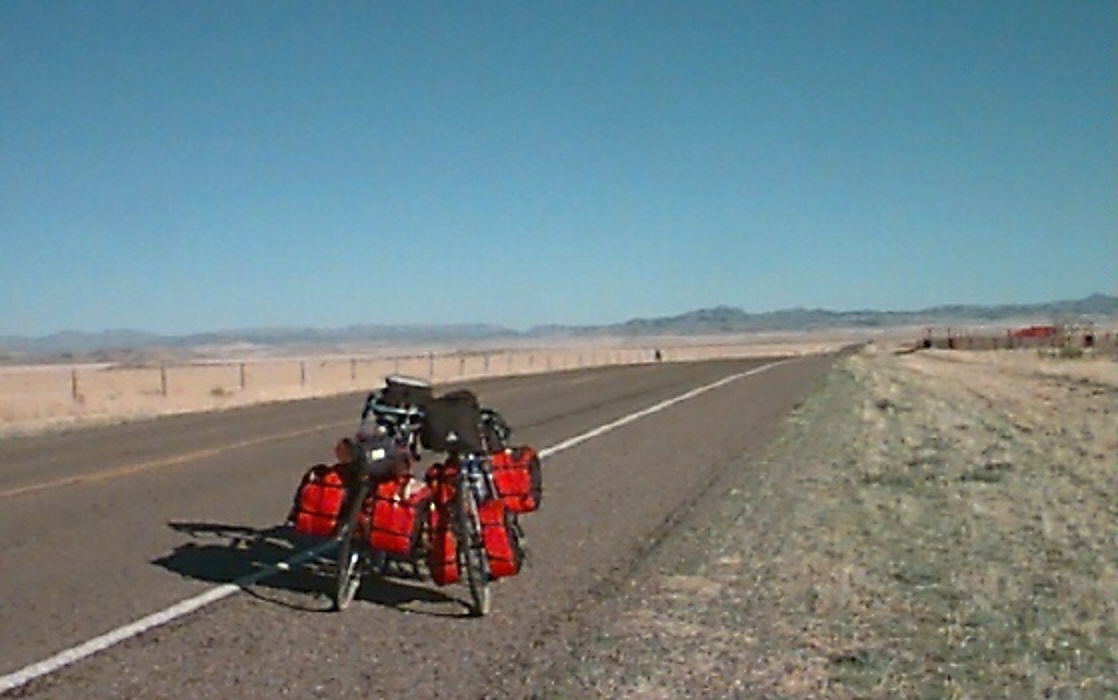
An easy day's ride, we thought. Various estimations put the distance around Lake Maninjau from 55 kilometers (Norma's) to 70 kilometers (Indra's), with Klaus taking the middle path at 60. Klaus had breakfast with us this morning, on his way to work across the lake, where he trains employees of the National Electric Company. The friendly German also said that the road surface shouldn't be a problem with our bikes. Did he know Norma in Padang? \"Of course,\" came the reply, with a sous-entendu \"duhhh!\" So we set off around the lake in a clockwise direction, our hearts light and our spirits soaring.
It was a beautiful day, with the mountains ringing the lake visible through the haze. The traffic-free road passed through a number of small villages featuring beautiful old wooden houses, most of them two stories and intricately carved. An unexpected delight was the absence of children screaming \"Hello Mister!\" Apparently *bulehs* are fairly commonplace here, and it felt great being relatively invisible for a change. The cool air, pine trees and the glimmering green surface of the lake furthered the impression of having left Indonesia behind for a secret \"Lost Horizon\"-style Shangri-La. The illusion was abruptly shattered, however, when the road turned into a path barely suitable for herding water buffalo.
It made Baluran in Java look like the autobahn. There's no telling if the scenery matched that of the previous hour's pedaling, since getting our butts down the road in one piece required every once of our concentration. After a couple of kilometers of being jolted along over the boulder-strewn surface, we stopped at a *warung* for water and asked the proprietor if and when the road got better. \"Only two more kilometers like this; then it gets better. No it's not asphalt, but it's *bagus*,\" the scrawny gentleman promised. Three bone-rattling kilometers later I contemplated turning around and calling him a liar, but since that would entail backtracking along a stretch of road I never wanted to see again, we pushed onwards.
This is the psychological trap that made us continue around the lake, with over 20 kilometers on a miserable excuse for a road. More than once we had to get off and push, so big were the stones and so steep were the slopes. Over and over we marveled how circumnavigating Maninjau by bicycle was promoted so heavily in all the tourist literature we had seen. And how any German could think that this road was suitable for any kind of vehicle was totally beyond us. Finally, just as I was about to heave my bike into the lake and swim back across, we rejoined the sealed road along the north end of the lake.
It was like entering another dimension. Our tires whirred along the smooth surface, transporting us along at five times the speed to which we'd almost become accustomed. Once again we were able to look around and enjoy the scenery. One thing that surprised both of us was the number of dogs running around. They looked much healthier and happier than any dogs we'd seen on Bali and Lombok, and some were even being walked on leashes. Obviously they were being kept as pets, which seemed somewhat at odds with the ultra-Islamic reputation of Sumatrans. Odder still were all the baboon-like monkeys, also led on leashes with the tenderest of care, usually by older men.
When I saw one of these animals up in a coconut tree, I figured it out, though: the monkeys were trained to harvest the heavy high fruits. As hard as the ride was, we still made it back to our hotel before noon, with plenty of time for a swim in the lake before slogging up the famously steep 44-switchback hill to Bukittinggi. --by chartered transport, of course. Ever since we'd arrived in Sumatra everyone asked us, \"have you been to Bukittinggi yet?\" or \"have you just come from Bukittinggi?\" From their questions I assumed that there must be something special to see there.
There's no question it is bustling. There are nearly one hundred thousand inhabitants in what appears to be a market town. We consulted \"the book,\" which advised us that there was a great view to be had from an old Dutch fort perched in the center of the city and we struck out for it after checking in to our hotel. On our way we meandered through the \"high market\" named so because it sits, logically, above the low market. A better name might be the \"snack market\" because every vendor seems to be hawking crackers of some sort, many of which are made of fried and flavored tapioca.
We sampled a little of almost every snack type walking through the high market. Because we bought something from one of them we were, therefore, likely customers and were offered tastes by every other vendor. We'd almost forgotten about our intended tourism having been distracted by all the junk food. Somehow we regained our composure and struck out towards the fort. The fort was part of the touristic epicenter of Bukittinggi, sharing grounds and entry fee with the municipal zoo. At the entrance the guard re-sold us used tickets at a ten-percent discount and pocketed our entry fee. We used our savings to buy peanuts to feed the animals.
Within a few moments of entry Andy had given all the peanuts to a very well fed group of elephants whom where remarkably adept at charming food out of zoo patrons. As the sun started to dip towards the horizon we walked across a suspension bridge to the fort. We were disappointed looking for a path or stair that actually led to the fort finding that one could only walk around the gardens and see the not so impressive view from there. A couple of Sumatran ne'r-do-wells started a palm tree on fire just as we passed them and I became incensed at the destructiveness of the act.
At first I thought we'd track someone down to put out the fire, but then I realized that with any delay the palm would be engulfed in flames. I saw a broom of traditional Indonesian construction, (a bunch of twigs bound to a stick) leaning against a wall and took action. I began to beat back the flames with Andy's encouragement. The flames were extinguished before the fire got the best of tree much to the amusement of onlookers. Enticed by a commercial minded tour operator we decided to be \"real\" tourists for once. We booked a bus tour of the surrounding areas.
The itinerary sounded completely uninteresting until the agent said the magic word: \"bullfight\". I imagined a caped dude wearing a funny hat inflicting mortal pain upon a poor defenseless animal amongst the cheers of a drunken crowd and was immediately sold on the idea. The next day the bus called for us at 8:30 sharp and we entered an exhaust-stinking little minivan with an older Indonesian couple already on board. We'd been told that there would be seven of us in the van plus the driver and guide and I was having a hard time imagining being in this little van with eight other folks.
There were clearly seats for only eight. Three Dutch sisters joined us at the next stop and our guide solved the problem by giving up his seat and squatting against the front seats looking back at us and beginning his guide spiel. He reviewed our itinerary and made us introduce ourselves. *Pak* Rawan and *Ibu* Nana were the couple; Francisca, Sasha and Irena the Dutch girls. At our first stop it became clear that we were not the only tour bus on this trail. Every *bule* in Bukittinggi seemed to be in a similar group visiting the same sights. The first stop was a spice plantation.
There we learned that Sumatran coffee was on the way out because the price was too variable for the local farmers to depend on. In the place of coffee the locals were all substituting cinnamon. Andy and I looked at one another knowingly when we heard this. Often if a business idea works for one person in a region, everyone in the area is doing the same the next week. The only problem for the people engaging in the business is that they all compete and then the price drops to the point of it being barely economic to continue...and the cycle continues.
We also learned the thousand and one things that you can do with a banana and its host tree before moving on to a coffee plantation. There a waterwheel-powered mill was pulverizing recently roasted coffee. The wheel rotated a camshaft that lifted and dropped pestles onto the coffee that was tended by a woman using her bare hands to add more coffee and scoop out the grounds. The system left me wondering how often a finger made it into the coffee and why they didn't strap a generator onto the waterwheel and buy a dozen little Braun coffee grinders. Surely the process would have been safer if not as picturesque.
Speaking of coffee, the trip could not be complete without a stop at a coffee shop/gift shop where we could sample and buy all the things we'd seen so far. As we introduced ourselves our guide (whose prose most resembled that of a third-world game show host) asked us to tell us what we wanted to see most while touring around. Sasha told the group she wanted to learn more about the cultivation of rice. By this point Andy and I were both experts on rice cultivation and could recite the steps in our sleep, which are: 18. Mature rice stalks from the last harvest are laid in a padi and sprout into a carpet of new rice sprouts.
19. The sprouts when large enough are bundled and taken to a prepared rice padi where they are planted at intervals of 10 to 15cm. 20. The rice is weeded, fertilized and kept wet until it matures. 21. When mature, the padi is drained and the rice is cut and stacked 22. Shortly or immediately thereafter the rice stalks are pounded against a wood beam over a tarp on which the grain is collected 23. The grain is dried, most often on the side of the road or at a collection center where they have a drying platform constructed of cement 24.
The grain is separated from the chafe by tossing it in the air allowing the wind to separate the two 25. Ducks and goats are allowed to graze in the padi for lost rice, their dung fertilizing the soil 26. Unused and uneaten remains are burned and tilled back into the soil 27. The padi is prepared for the next planting. On the way to lunch we stopped and viewed steps four, five, two and ten in that order. At the first stop Sasha was intent on participating in the process, much to the amazement of the harvesters. As for the fieldworkers, one boy was wearing a purple satin blazer with puffy shoulders, which left many questions unanswered for us.
When we arrived at the stop where they workers were replanting the young rice Sasha and our guide rolled up their skirt and pants, kicked off their shoes and waded into the rice field. I thought we'd lost the two of them for good while Pak Rawan and Ibu Nana giggled. Our guide Tono waited until afterwards to tell Sasha that one could get leeches while planting rice. We didn't see any of the other tourist groups planting rice this day, but they all did show up at the Padang style restaurant for lunch. Padang food itself might not be familiar to Americans but the style of service might.
It most resembles the Dutch-Indonesian style of eating *rijstaffel* (rice table) where many little dishes of spiced meats and vegetables are laid before you. The big difference is that you pay for only what you eat. My favorite was a tough and dry quarter chicken flavored with a spicy red pepper sauce. Pak and Ibu took more photos than the entire balance of the bus put together. No photo could be complete without one of us *bules* in it. For Pak it had to be one of the Dutch babes and for Bu it had to be one of us. Pak allowed Bu to touch the camera sparingly for good reason.
Andy and I had a giggle when we spotted her pointing the business end of the camera at herself when trying to shoot a picture. It left us wondering if they had albums full of Pak with white girls and all the others close-ups of Bu's nose. After lunch I was wondering why we didn't find a half-day tour in place of a whole day tour. We toured the former residence of a local king housed in a massive Minangkabau-style structure recognized by its roofline. The Minangkabaus fashion the eaves of their homes to resemble the horns of bulls. Legend has it that the Minangkabaus won a bullfight against the Javanese using their cunning ways, thus they got their name \"the winning water buffalo\".
Here is how they did it: First, it should be noted that a bullfight is actually a fight between two water buffalo that wrestle one another with their horns until one chases the other off. The chaser is declared the winner. The Minangkabaus took a young buffalo and put fake horns on it. The horns had razor sharp points. They then deprived the baby of its mother's milk for some days before the contest. When the young *kerbau* saw the elder one in the ring it immediately went for its belly to find milk, goring the adult and winning the match, thus spoiling the myth that cheaters never prosper.
The King's Palace was just not all that interesting, nor were the three following stops where we swam in a big trashy lake, saw weaving and word working. However, the bullfights were a slice of culture that I'd not seen yet \--Indonesian mass entertainment. We arrived at the Indonesian fairground equivalent just after a heavy downpour had rendered the fighting ring and spectator areas alike sloppy and muddy. Bullfight fans and bulls surfed the gray muck, the former placing large bets on the event, though signs everywhere declared that gambling was strictly prohibited. In anticipation of the first match the field was cleared and the *kerbau* were introduced.
They seemed content just to nuzzle one another though their tenders tried to rile them by pounding their butts and balls with sticks. When it was obvious to all that these bulls were just too friendly to fight the match was called and all bets were off. The Indonesians in the audience seemed to be more excited about the second fight. More and more folks arrived, crowding the viewing area that was little more than a high place above the fighting field. The arena itself was cut from a hill and the fans lined the resulting little railingless cliff, many risking their well being by standing close to the mud slick edge.
When the second set of bulls locked horns dragging and pushing each other around the crowd shouted and screamed for their favorite contestant. After about five minutes the loser was chased off into the crowd, who reacted by screaming and running into the surrounding trees. I could hardly distinguish the third fight from the second, so sparing the description of it we then dragged our now muddy tourist butts to the bus and returned to Bukittinggi. After clogging the tub with mud we adjourned to dinner at a Chinese restaurant that our German friends from Padang had recommended. On the way we passed the town's square housing the towns pathetic monument, the *Jam Besar* (big clock) \--little more than a cement tower leaning slightly westward.
At the restaurant we saw every other tourist from the day. Our three Dutch friends arrived and sat with us through a tasty dinner served by the queeniest waiter we'd come across in some time. Amusement came when he offered us the tropical fruit salad for dessert especially since it came with an explanation of the produce and where it came from which we named the \"fruit demo\". Dinner was punctuated by street urchins trying to sell us shoe (or should I say sandal) shines and guides their services. It all reminded me what it is like to travel like a real tourist.
I felt more like a walking cash source than a curiosity, and I was missing rural Indonesia.