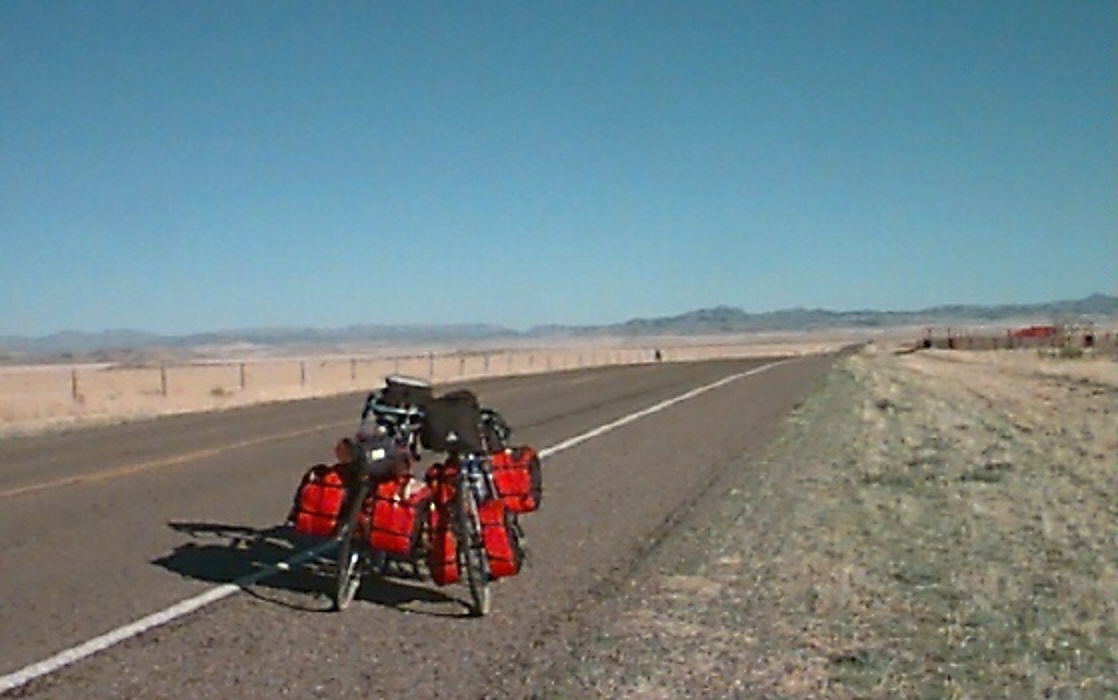
Legs quivering just a little I mounted my bike and we were on our way to our first riding day in our very brief tour de Malaysia. Yesterday's nervous stomach still with me, I wasn't sure about whether I should ride or not, but was willing to give it a try. The option to take some form of transportation would be there if I couldn't continue. As we rode to the ferry to peninsular Malaysia a few things were obviously different here than in Indonesia. First of all there were huge numbers of private cars all in a rush to get somewhere.
Even in their haste they were very orderly and careful to give us a wide berth. The vehicles we had to watch out for were the buzzing scooters that wound their way around town without regard to anything or anyone. At least we were traveling closer to their speed while on our bikes in contrast to the day before on foot where we were at a distinct disadvantage. Along with finding more autos we discovered that there were far fewer bikes and the roads much wider and better maintained. Shortly after beginning to ride we'd tagged Malaysia as the Ohio of Asia.\ Our map of Malaysia was dreadfully insufficient.
It marks none of the small roads or the ferries we'd need to take today. We asked a number of folks for advice on how to proceed to Alor Setar with most everyone replying we'd have to take the main road. Just before we succumbed to the idea of toughing out the miserable and long highway route a cyclist named Chew See Lim came to the rescue and gave us detailed instructions on how to find the ferries and which lanes to take. He even escorted us along the first ten kilometers. The whole idea of the journey appealed to him except that it provided no income.
This clearly violated his Chinese values. Malaysian villages, at least in this area, were drastically different than their Indonesian counterparts. They looked far more prosperous, with nearly every house sporting a shiny four-wheeled vehicle in its driveway or under the house. Speaking of the homes, they are built on wood columns sitting about two or three meters from the ground. We assumed that the space below the house was reserved for domestic animals, though few people keep them now. Many families have finished the lower part of their house with masonry to make a ground floor. Few of the picturesque houses on stilts remain.
Our first little ferry ride made me understand why so few people knew about the boat alternative. Descending the rakishly slanted and tilted stone steps with our bikes was difficult enough, but subsequent hoisting of the bikes onto the rowboat required more dexterity than I felt capable of. Somehow we managed to load and unload the bikes before proceeding to the next ferry. Riding quickly through coconut palm studded villages we arrived at the beach. Ferry is too generous a description for the boat we took across the bay. I little outboard launch took only us across. On the other side similar acrobatics were required; we had to carry our bikes over the rocky breakwater to continue our ride.
After a drink we set out in the now blistering heat. I made Andy stop frequently so I could cool down. I'd not eaten so many popcicles since I was a child. Chew See Lim had warned us that the afternoon would be hot and that we would face a head wind most of the latter part of the day. Unfortunately for us he was correct. Normally a headwind would cool us off but the effect was like being in a convection oven. Hot moist breezes blew across the massive fields of wet rice into our faces. One surprising thing was that in all of the acres and acres of rice there was nary a person tending to it.
It was very surprising after Java and Sumatra, where every square inch of rice padi seemed to have personal attention daily. Later we saw that indeed there were vast differences in rice cultivation methodology; can you spell m-e-c-h-a-n-i-z-a-t-i-o-n? Huge motorized rice harvesters dotted the roadside. We detoured a little on our way into Alor Setar. Road signs that had clearly marked our route suddenly disappeared and we went off track for a few kilometers. We found our way back and delighted in the tailwind that pushed us the last bit into town. The surrealistic state of Alor Setar was perplexing. A huge beautifully maintained Mosque set on an expanse of green lawn sat in the foreground of the massive pink stuccoed mall.
A massive telecom tower a la Deutschland sprang from the center. At first we couldn't figure out how a podunk town like Alor Setar rated such development until we read that the president hails from here. After a tour of town we opted to see \"Lost in Space\". Neither of us were expecting much of the movie and were not surprised by anything but the quality of the theater, its screen and sound system. Are we in Asia? Andy's supposition about the movie was that they'd had a bunch of leftovers from the special effect cutting board (perhaps the script too...) from \"Starship Troopers\", \"Alien III\"
and, perhaps, \"Toy Story\" splicing it together and making a new movie. When we exited the movie darkness had fallen upon Alor Setar. It seemed even more artificial by night. The telecom tower that had looked big by day was overwhelming by night. A glass elevator to the rotating restaurant revealed the (lack of) splendor of the surrounding countryside. Perhaps one day lights of homes and streets will spread out around the tower like the carpet of lights beneath Chicago's Sears Tower, but for now there is mostly darkness. If President Matahir has his way, perhaps we will see a cityscape like that.
He is planning to try to increase Malaysia's population four-fold by 2020. We both snickered at the idea and surmised that he could probably get a little help from neighboring Indonesia. On the way down the elevator we had an experience that characterized our interactions with fundamentalist Muslim women. Andy asked the lift operator in Malaysian and English in what year the tower was constructed. Her head covered by a white scarf, she hesitated and answered \"yes!\" We surmised that the *jelbeb* (headdress) indicated that she was out of service, sort of like the canvass bag they put over a parking meter that doesn't work.