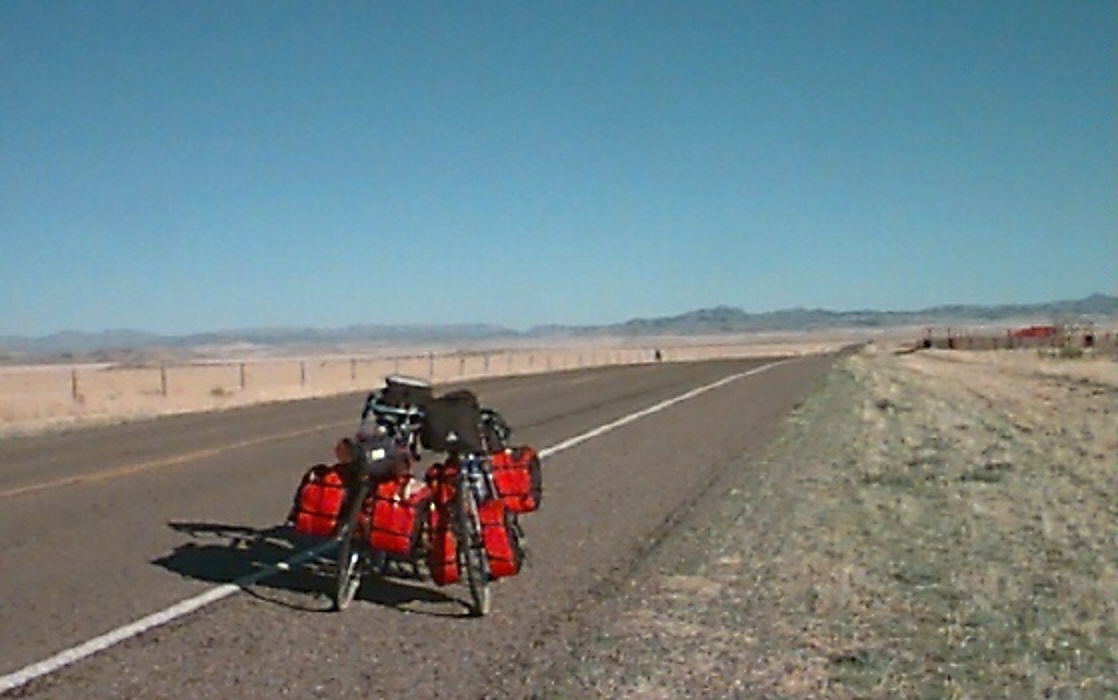
Last night Peter Lorre advised us not to take the shortcut back to the main highway, even though it would save us fifty kilometers of riding. "It is a broken road, and the people are hostile peasants, not good people. They will see your white skin and think bad things." Of course we ignored his adamant advice, which was spot-on accurate regarding the road but totally off vis-à-vis the locals, who couldn't have been more friendly or gracious. Practically everyone we passed smiled and waved at us. Many peasants tilling the soil dropped their tools when they saw us, pressed their hands together, bowed and emitted gracious "*namaste*"s.
When we reached a closed railway crossing the many people waiting patiently on either side for a train to pass insisted we go through (the train was nowhere in sight), going so far as to hold the gate up for us. Further down the road a whole crowd of villagers screamed "Stop!" at me. Taking them for over-friendly voyeurs, I smiled at them and continued on. But when their shouts grew more plaintive I stopped at a safe distance, at which point a wizened old man sprinted up to hand me a bungee cord that had fallen from Fred's bike. As friendly as the people, and as beautiful the scenery on this forbidden shortcut, it was nevertheless a relief rejoining scary highway 8, since our butts had just about had it after 25 kilometers on a miserably bumpy road.
The traffic was mysteriously much lighter today at least, but the surface was nowhere near as good as yesterday's butt-candy. The remaining 20 kilometers to the Gujarat border were mostly downhill, twisting down an endless series of curves, yet not nearly as fast as they could have been due to the rough surface. We had lunch at an RTDC (Rajasthan Tourist Development Corporation) place at the border hamlet of Ratanpur. A pair of Indians at the table next to us horrified us by guzzling down four one-liter bottles of beer in less than fifteen minutes. Gujarat, you see, is famous for being a fanatically dry state (folks attribute this to Mahatma Gandhi, a native son and fervent teetotaler).
We only hoped that our boozing friends were headed in the opposite direction... Our first hours in Gujarat were terrific cycling. The mostly quiet road gently descended through verdant hills, and a healthy tailwind pushed us along. My first impression of Gujarat was how green it looked compared to dusty brown Rajasthan. After an hour and a half of ultra-swift pedaling we stopped at the fanciest *dhaba* we'd ever seen --sparkling clean, with a vast array of goods for sale, an attractively landscaped lawn and Vadilal ice cream (a delicious Jain-made treat that would quickly become a BikeBrats staple). When the green valleys and hills softened to an undulating plain, camel carts suddenly reappeared.
We'd hardly seen any since Sawai Madhopur (India's camel capital?) and I was overjoyed to see them again, since I associate them with everything I love about this country. With the wind at our backs we felt strong enough to make it all the way to Ahmedabad, but it would soon be dark. At Himatnagar we looked around for acceptable accommodation, and when none was found we hastily decided to commandeer a Commander --a cheap Jeep-like substance of Indian manufacture. This was pretty easily arranged, though the masses of onlookers we attracted made it a bit trying on the nerves. Our driver quoted a reasonable price of 400 rupees to take us to a hotel in the center of town and we agreed without haggling.
We knew from experience that Commanders are the blight of the Indian highway network, and it was unsettling to see how they operate from the inside. Two assistants sat in back with the bikes, watching the heavy flow of traffic for holes to dart through and instructing the driver --pressed against the door for the best view---accordingly. It was a white-knuckle ride, to say the least; we held our breaths most of the way. At a small crossroads we came to an abrupt stop. "Here Ahmedabad, Nehru Bridge," croaked our driver and his two minions, rather feebly. Dumbfounded by the lameness of their attempt to swindle us, I vowed not to tip them a paise and curtly instructed them to drive on.
The formerly amicable feeling in the car (or so I had thought) soured. Ahmedabad was still 25 kilometers away. Once we began to penetrate the vast city it became clear that our bumpkin escorts hadn't a clue as to where the Nehru Bridge was. They asked everyone in sight for directions, and without our assistance in the matter they'd probably never have found it. When we pulled up in front of the hotel the driver and his pals pulled yet another stunt. He told us that the price was now 500 rupees (Ironic, since that was what I'd planned to tip him before his first attempt to deceive us), but we held firm at 400 rupees.
Of course the commotion it stirred up attracted the entire hotel staff, plus half the surrounding neighborhood. In the end Fred had to place the 400 rupees on the ground since the Himatnagarians refused to accept it. Princessing out for dinner at the Holiday Inn next door seemed an appropriate way to end the long day. We ordered Mughal and Jain dishes, all delicious and served with just the right amount of obsequiousness. A stroll around the neighborhood afterwards yielded the usual verdict: Fred thought Ahmedabad was a filth-smeared dump, while I found it charming, funky and steeped in mystery. The next day we were tourists.
We had been told that the Calico Museum of Textiles was not to be missed, so we headed there first thing for their morning tour. Quite an amazing place it was, too, housed in the magnificent residence and garden of a wealthy family of fabric dealers. Our guide (you can't wander around on your own in this museum as you could very easily get lost) rushed us through various folk exhibits, describing different types of worship and pointing out details on perfectly reconstructed temples and houses --all integrated into the massive palace. There were precious bronze objects, ancient texts and maps and exquisitely detailed miniature paintings.
Best of all, though, was the textiles portion of the museum, which is probably the best of its kind assembled anywhere. Most impressive was Shah Jahan's ornately decorated hunting tent, hanging from the ceiling of a massive room housing countless other treasures. We saw costumes of kings and queens, ancient *ikats* from Indonesia, as well as *batiks*, shawls woven from precious metals and mind-bogglingly intricate tie-dyed and embroidery work from the tribal people in Kachchh (I swear that this is the way it's spelled on my map), the westernmost part of Gujarat state. Our plan had been to proceed directly from the museum to the day's only screening of "Fire"
in English. We'd been reading about the brouhaha over the film in the newspapers every day since arriving in India, usually on the front page. Treating the story of two married women who develop a lesbian relationship and leave their husbands, the movie is deemed "obscene" by the more conservative Hindu groups --most notably the Shiv Sena political party. All across India cinemas showing the film have been picketed or even burnt down in protest. We figured we had to see it, but missed our chance in Ahmedabad while we ooh'ed and ahh'ed over fabulous fabrics. Little did we know that we wouldn't have another chance in India, since the film was ordered to be sent back to the censors the very next day.
The remainder of our day in A'bad was very busy. First stop was the Gujarat Tourist Bureau, where we tried to squeeze information out of an elderly ignoramus, followed by a first-rate lunch at the elegant Hotel Cama and a peek into the amazing textile-oriented gift shop downstairs. From here we proceeded to the train station to book train tickets, locking us into an itinerary for the next two weeks, then on to the best Internet café we've been to anywhere, called Random Access, in the obviously wealthy part of town across the river from where we were staying.\ We made it back just in time for our rendezvous with Satya and his extended Jain family, the ones we'd met in Sawai Madhopur.
They arrived late looking very elegant indeed, just back from a wedding. Satya's perpetually smiling and radiant aunt (whose name I've unfortunately forgotten) was wearing a gorgeous tie-dyed sari like the ones we'd seen earlier in the museum. Biren, Satya's skinny, hyper-energetic uncle, told us that everyone was waiting for us back at his place, but he wanted to give us a little tour of Ahmedabad by car first. It was terrifying, since Biren is perhaps the worst driver in all of India (no small claim). He swerved through the dense traffic as if oblivious to everything around him, placidly chatting all the while.
Somehow we made it back to his family compound (across the river, of course), where we met up with all the same people we'd seen in Sawai Madhopur. We sat on a huge pillow-covered dais with male members of the family and looked at blurry photos of tigers. Biren also showed us pictures of Palitana --where he was delighted to learn we were heading---and told us that their whole family goes there in pilgrimage every year. In fact, we could stay at his cousin's guest house there. After a while we all trundled into three or four cars and headed off into the night for ice cream.
The place they took us was a riot, an Indian version of a strip mall lined with ice cream shops. Fifties-style carhops compete for business and bring the orders to people's cars while the customers put all their energy into checking each other out, trying to figure out how they fit into the societal hierarchy. The ice cream was good, too. Satya scoped out some of the female patrons and claimed breathily that "women are the spice of life" --thus dispelling our suspicions that he might be family. We had hoped that he might provide us with entree into the Gujarat homo scene, as well as insights as to how upper-class Indian (and Jain) gays cope, but retired to our beds as clueless as ever.