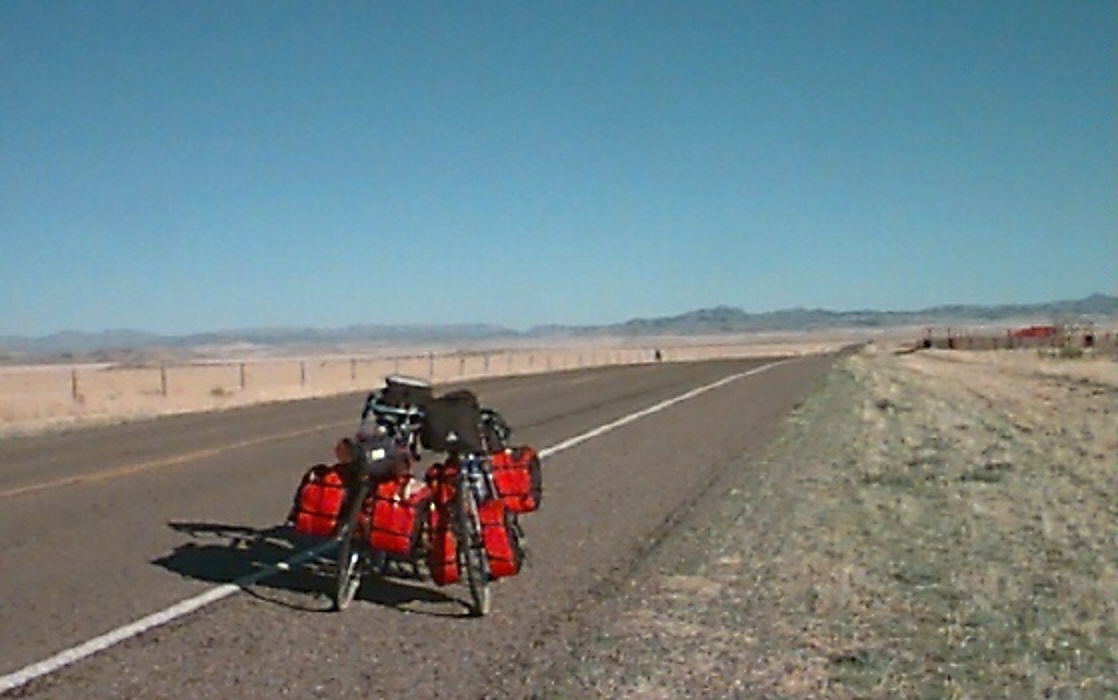
\"The boat to Haranggaol? Ohhhh... It already leave.\" I suppose we shouldn't have been surprised, since we've found boat information (and not only in Indonesia) to be unreliable at best. Everybody we asked yesterday told us it left at seven; now they were saying six, making me wonder how anyone gets on boats at all. Nevertheless, the words were hardly welcome, since it meant sixty extra kilometers of riding over what looked to be mountainous terrain. Worse yet, we'd risen before dawn and pedaled seven kilometers without so much as a cup of coffee. In fact, I went the whole day without coffee.
Fred says my resulting crankiness manifested itself in a number of ways, while to my mind it was one of our more enjoyable riding days yet. It was certainly one of the most challenging. Rather than taking us to a port on the north side of the lake as planned (and Toba is big --the biggest in Southeast Asia), our vessel dumped us back in Prapat, a place neither of us was eager to re-experience. We pedaled straight out of town, knowingly ignoring one-way street signs in order to avoid an unpleasant hill. Soon we were pumping up a giant hill, though, following the main highway to Medan up the lip of the crater encircling Lake Toba.
A half-hour later we had climbed three hundred meters. The view of the lake would have been fantastic were it visible through the forest-fire haze. At our turnoff that led northwards following the lake, a handful of lounging cops advised us on what lay ahead. \"It goes up about two kilometers more,\" said one, \"and then it's all downhill to Brastagi.\" Estimations of distance varied from forty to a hundred kilometers. The cop who thought it was a hundred k was right, while the one who told us it was mostly downhill was egregiously wrong. Indeed, our first two kilometers on the side road took us sharply up --through lush jungle silent save for animal sounds---but it was hardly to be the last hill.
What made all the climbing tolerable were the cool mountain air and the unbelievably quiet road, most of which had been recently resurfaced. As we passed through some rough looking assemblages of houses that pass for villages in these parts, I wondered what it would be like to live in such a vertically-oriented environment, perched above a virtually inaccessible expanse of blue. Many of the people had a wild mountainy look to them, with unkempt hair, dirty clothes and skin and rough manners. As we passed sweatily by, most were too stunned to muster the meekest \"hello Mister,\" for which both of us were grateful.
Some did manage hearty Batak greetings of \"Horas!\" though, a word that's fun to shout back (as well as being the alpha and omega of my Batak vocabulary). We caused quite a stir when we stopped at a roadside warung. A middle-aged male patron wanted to impress his pals with his English abilities. \"Where you prum?\" came the inevitable question. When we told him, everyone nodded their heads and shouted excitedly, \"Amerika, Bill Clinton!\" Over and over, our new best friend tried to convince us to have some tea, but given the general hygiene standards of the place, we thought it best to stick to bottled beverages and headed out as quickly as possible.
The road climbed up a long series of switchbacks from here, snaking through rock-strewn forests of pine. We knew we were near the top when a huge broadcast antenna materialized out of the mist before us. My altimeter read 1400 meters before we plunged back down along a semi-surfaced road that dumped us into the vast vegetable-covered plain containing Tigaringgu, a godforsaken crossroads where we had lunch. After cruising up and down the main (and only) street, we settled on the cleanest-looking and most popular eating establishment, the first Padang-style restaurant we've seen where at least ninety percent of the dishes were unappetizing fish smothered in chili sauce.
I ordered the only item that looked and sounded fish-free, spicy tempeh, and was dismayed to find it contained dozens of tiny fish heads. Normally Fred's the picky eater in the family, but he chomped it all down as I picked out as many of the staring minnow eyes as I could. Though not even he would touch the apparently poisoned soup that was plunked down before us. As we ate, the other customers (all men) stared silently as the employees (all women) giggled hysterically, making for an altogether self-conscious dining experience. Tigarinngu marked the kilometric half-way point of the day, and we'd already climbed nearly 1200 vertical meters, so the relatively level terrain which ensued came as an immense relief.
The road's surface alternated mysteriously between excellent and execrable, as it had been resurfaced in utterly random stages. Miraculously, we found Magnum ice cream bars in a gritty-looking town called Seribudolok. I asked our sullen hostess what it meant. \"A thousand mountains,\" she explained. When I told her I thought we'd climbed them all today, she indicated a nearby volcano and suggested we climb that one, too. No thanks, I said, pointing my bike in the other direction. Our cultural diversion came about an hour later. We had passed into the land of the Karo (as opposed to Toba) Bataks, and I was anxious to see an example of their traditional architecture.
The small village of Dokan fit the bill nicely, with a collection of crumbling old multi-tiered wooden houses looking vaguely like furry flying saucers decorated with cow heads. Back on the main road, the closer we got to our goal, the busier traffic became \--mostly heavy trucks hauling god-knows-what, driving straight down the middle of the road as if it had been built uniquely for their benefit. Villages became more abundant and less pleasant to cross, especially since school had just adjourned for the day. As well as screaming \"Hello Mister!!\" at full volume, many of the little monsters --boys and girls alike\-- would slap our arms, grab at our bags or block our path.
When one little urchin (not the first) picked up a stone and chucked it in our general direction, I leapt off my steed and pursued him on foot around a car, through a chicken coop and into the rice fields before giving up. Fred said he was glad I didn't have my pepper spray handy... Climbing up a hill into the busy town of Kabanjahe, I got miffed by a persistently honking Kijang (Indonesian sports utility vehicle, and the type of auto most likely to contain buttheads). When I turned around to give the driver my most convincing one-finger salute, Fred wisely noted that it might be best to charter it the remaining ten kilometers to Brastagi.
Another dollar well spent, it turns out, since it was uphill (albeit gradually) the whole way, along a miserably busy road. At first Brastagi didn't look too appealing: a busy main street lined with ugly concrete blocks. The people at the tourist information office were surprisingly friendly though, and even proved informative. As well as recommending a hotel for us, they told me that the back road we planned to take to Bukit Lawang tomorrow was \"a Dutch road\" now only suitable for trekking, and that the only way was along the main highway through Medan \--not exactly welcome news, but helpful.
The place they'd recommended was uphill of course, a gigantic monstrosity of a \"resort\" catering to nouveau riche Chinese from nearby Medan, more of an anthropological encounter than a hotel. We were bewildered to find it bustling with people, piling out of their shiny new Mercedes. Normally in Indonesia we're the only guests at any given hotel, and this was Monday. Someone explained that tomorrow is yet another national holiday, \"an Islamic one\" this time (if someone could convince the Indonesian government to observe Jewish holidays, no one would ever have to work). Fighting his way through the throng of hyperactive Chinese families --invariably accompanied by their white-uniformed, darker-complected *pribumi* nannies---Fred scored us the last room in the hotel.
\"It's a small one,\" he warned, \"and the worst value we've found anywhere in Indonesia. But the guy at the desk says there are no more rooms in town due to the holiday.\" After stowing our bikes under a staircase, he led me up to what he called \"the servants quarters\" --and that's exactly what the room was, a tiny garret attached to a larger suite. If any doubts remained that the room had any other intent, the diagrams explaining how to use the western-style toilet dispelled them. Nevertheless, there was enough room for our gear plus two stiff-n-sore bikebrats. Somehow we found the strength to go for a sunset walk around Brastagi's hillside suburbs, where we passed by a large number of more savory-looking lodgings, all of them looking empty.
In the fading light, we descended the hill along dirt pathways through Brastagi's *kampung* suburbs, where I was surprised to see peasants returning straight from the carrot fields to respectable-looking houses with roofs sprouting parabolic t.v. antennae. We ran into one of our friends from the tourist office earlier, and he recommended a Chinese restaurant. Not surprisingly, it was filled with high-decibel families from our hotel. But the food and the service were delicious. The owners --Chinese homos *d'un certain age* and identical twins---gazed at us knowingly from behind the cash register. We nodded our approval on their fine selection of the service staff and patted our full bellies in satisfaction before heading out into the cool mountain air.
The main street that had looked so dismal only a couple of hours earlier was now teeming with life. Makeshift restaurants were set up all along one side of the street, and the still-open shops were doing brisk business. Hasn't anyone here heard of the *Krisis Moneter*? One interesting fact in our guidebook might have the answer: the province of North Sumatra (and there are eight provinces on this island alone) accounts for more than 30% of Indonesia's exports. Up to this point I had thought that the road to riches in Indonesia was paved with rice, but North Sumatran products like cocoa, rubber and coffee are what fetch (currently overvalued) hard currency.
I wonder if for some of the people staying at our hotel, the Krismon is actually good news.