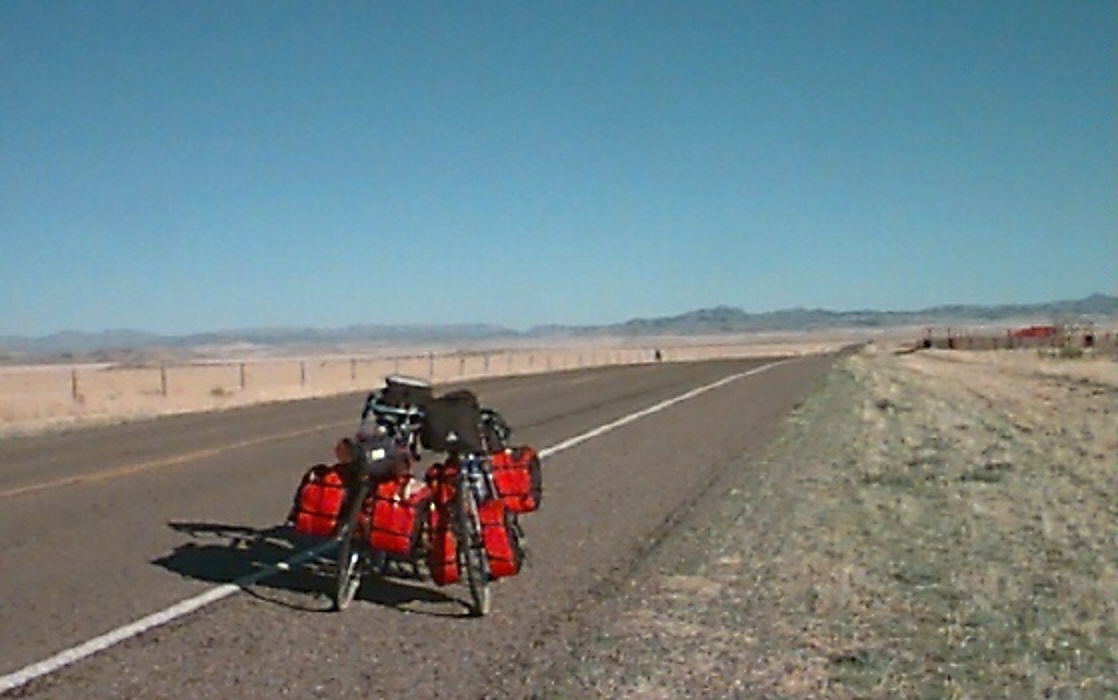
We began the day with a rather feeble attempt at finding transport to Comal, some twenty kilometers down the main highway. When none magically appeared (as it usually has) we decided not to waste the precious fleeting moments of relatively cool air, bite the bullet, and give the Jakarta-Surabaya highway a shot. It turned out to be not so bad, with respectful traffic moving at a reasonably slow pace. Nevertheless, after an hour or so of breathing bus fumes, it felt good to turn off it onto a deliciously quiet side road along a Dutch-style canal. We wound our way through kampungs to scruffy Comal, the day's first water stop.
Out in the rice fields it was planting day. Hundreds of peasants were busy moving young rice sproutlings from their vivid-green carpet-beds into the main fields, spacing them carefully in the newly-tilled muck. Aided by a decent tailwind and the smooth surface of the empty road, we cruised across the immense coastal plain, conscious of the rapidly rising temperature. Our map showed only one road in this part of the world, yet in reality the whole plain was crisscrossed with minor thoroughfares and canals, and we were soon more or less lost. Asking for the road to Cirebon --still quite a ways off---brought blank looks, so we indicated that we wanted to go east.
Just as it was starting to get really hot, our smooth road turned into cobblestones, leading to an old Dutch factory at quitting time. We were instructed by a wizened old man in a weird combination of police drag and a *haji* hat to follow a road resembling an ox track across a railroad bridge. \"It's just a regular road, but leads to an asphalt one,\" he apologized. The \"regular road\" was hell on our butts and our bikes, yet provided us with an insight into what most Indonesians have to endure every day of their lives. Other cyclists bounced along with us at an excruciatingly slow pace.
More than once along this stretch, we considered turning back, but the instructions had been accurate: after a couple of kilometers of Baluran-esque hell we were rewarded with a gleaming ribbon of shiny black bitumen. Water break number two drew a large crowd of gawkers, as interested in our bikes as in our ability to consume copious quantities of beverages and snack foods. They told us that Cirebon was still a good ways off and I contemplated riding all the way, wanting to get the most out of our last day cycling on Java. Fred, meanwhile, was already committed to taking transport from the next big town, and it didn't take long for him to win me over to his side.
More than any previous day in this hot country, I was feeling the effects of riding under the blistering sun. An hour or so along a flat, stimulus-free road brought us to the bustling market town of Slawi. When no air-conditioned Chinese restaurant appeared along the route, I stopped to ask a becak driver for a lunch recommendation. He suggested a bakso (noodles with fish balls) place a little further down the road. It was a sweltering little hole of a place with noodles far inferior to the ones we had the previous night. Fred made the mistake of ordering something called es campur when he saw one appear at a neighboring table.
The multi-hued concoction consisted of ice shavings, cream, chocolate syrup, bread, pineapple, strawberry jellybeans and a number of unidentified elements. We backtracked into Slawi's main intersection to get water and possibly arrange transport. The friendly woman who ran the store insisted we sit down and brought us fruit. When informed of our origins, she told us that the woman who owned the gold shop across the street had children in Texas and that we should go by and see her. Sure enough, every time we looked across the becak-clogged street an energetic Chinese lady would motion wildly for us to come talk to her.
Reluctantly, we headed over to meet her, and were pleasantly surprised. Using very passable English, the older woman introduced herself as Nyonya Rijeki, which means \"Madame Lucky\" \--a perfect name for a bordello-owner in prewar Shanghai, I thought. She offered us drinks and pulled out a seemingly infinite supply of family photos. \"This one, he live in Ft. Worth,\" she said, \"and has a very good job. I already visit him a few times but now the tickets too expensive and no one buy gold anymore. Before, I do really good business; that's how I paid for my kids' educations and why they can all live overseas now.
Slawi not a very good place. You boys need to careful. Don't eat in Indonesian restaurants --so dirty. And there's so much magic here. Many, many magics. And gangs too... For a ring they cut off your finger!\" I responded to this last bit of unsolicited information by saying we'd had no problems and that we were protected by our own magical talismans. She went on to tell us how she had just bought dollars the previous day in anticipation of her next voyage to Texas, and I began to suspect that she had been provided by some divine source. We were down to our last rupiah and it was Saturday, and we had no idea how we'd survive the weekend.
I cautiously asked if she was interested in buying any more dollars, and within moments Madame Lucky had her big safe open and was casually pulling out wads and wads of cash. The first and most pressing item of business taken care of, we asked Nyonya Rijeki if she had any ideas for finding transport into Cirebon. Immediately she pulled out her cell phone and barked into it. \"I call my driver. He know someone can take you to Cirebon with truck. But maybe you have to wait ...maybe an hour.\" We were then whisked back across the street, where Mme.
Lucky's daughter has another gold shop. The daughter had been schooled in Australia and spoke perfect English, but looked rather perplexed as to why two sweaty American cyclists were sitting in her shop. When an old toothless man in tattered clothes emerged from the back of the shop, Fred whispered to me in a pity-filled voice, \"That man just sold his teeth for the gold.\" But then Madame Lucky introduced the dotty-looking gentleman as her cousin, who proceeded to ask me a series of questions in wonderfully clear Indonesian. After about ninety minutes, though, Senor Toothless and I had pretty much exhausted our conversational possibilities, and Fred and I wondered how we could gracefully bow out of our predicament and arrange our own transport.
Just as we were about to make our move and hit the road, Mme. Lucky fluttered back across the street from her shop, informing us that our ride had shown up. \"I think it's best you put bicycle in box,\" she said, to which we groaned, remembering a number of unpleasant bike-boxing experiences. So we were delighted to find that \"box\" referred to the truck, a pick-up with a big fridge-looking box on top. The bikes fit inside easily, and soon we were on the road. The whole way to Cirebon I was thanking my lucky stars that we weren't riding.
The road was busy and narrow, and the thought of pedaling on it, being terrorized by the likes of our speed-crazed driver, made me cringe. After a while we pulled onto the main highway, much busier here than it had been this morning now that we were nearing Jakarta --exactly the nightmare road that I expected it to be. It was a miracle that we made it to Cirebon alive, even using a car. Once inside our surprisingly elegant room above Kentucky Fried Chicken, we were thrilled to find a proper shower, under which we scrubbed off several nasty layers of road grime.
How Madame and Miss Lucky had been able treat us with such respect and hospitality in our filth-encrusted (and surely malodorous) state remains a mystery. The name of this town had always been uttered in the same breath as batik. I'd imagined this burgh to be as delicate and refined as the hand-drawn (*tulis*) fabrics that came from the region. What I found in its stead was a busy grimy little town whose traditional *alun-alun* (square) had been replaced by two enormous shopping malls. Our hotel sat next door to the central and older of the malls above the Kentucky Fried Chicken.
We nicknamed the Penta Hotel immediately as the Hotel *Ayam Goreng* (fried chicken) and referred to it as such much to the amusement of Cirebonian *becak* drivers and to the horror of the hotel management. In all honesty I never \"hit it off\" with Cirebon despite its charms, which included a Wendy's Hamburger restaurant, Swenson's Ice Cream shop and the elegant newer Cirebon Mall which everyone assumed incorrectly was where we were staying. Transportation was the first problem we encountered in Cirebon. There are two means of conveyance in town, *becak* and bemo. Neither was very comfortable or convenient. *Becaks* in Cirebon were among the most festively decorated in Java and were something special to look at.
I'd describe them as the pedal-powered equivalent to a low rider taxi. Dayglow patterns, intricate murals, fanciful script and swooping fenders made you stand out in a crowd any time you rode in them. Unfortunately the *becaks* were not as comfortable as they were beautiful. First and foremost the seats were too narrow to accommodate two persons comfortably so we had to commandeer a flotilla of two to go anywhere unless one of us was willing to sit forward in the seat while the other sat back. Even then it was an uncomfortable ride for both mainly because the low rider effect was achieved by tilting the \"cab\"
portion of the *becak* precariously back so the seat was more like a recliner than a bench with a back. The angle of the seat forced the leaner to constantly slide back so the hips of both passengers felt the constraints of the width of the seat. Another compromise in comfort for the sake of form is the elimination of the springs that smooth out the ride. I'd already begun to dislike Cirebon on the way to the train station to book our passage to Jakarta when we found out we'd be staying an extra day. All the Sunday trains were *habis* (full or finished) and we'd have to wait to depart until the next day.
At the time I didn't hate Cirebon yet, so I reluctantly agreed to stay and extra day so we could shop for *oleh-oleh* (little gifts) for our family and hosts in Jakarta. On the way back to the hotel from the train station (this time in two *becaks* having learned our first transportation lesson and now sporting bruised hips) we got lost and ended up at the new mall instead of our hotel. We exploited the error and went to see the latest \"Alien\" movie that neither of us had managed to see in the States during our hiatus. During the film I spotted a funny translation that gave me some insight into Indonesian censorship (or was it merely a bad translation).
Winona Ryder was described by one of the less sophisticated characters as \"f\_\_\_able\", which the subtitle rendered as *\"baik-baik\"* or very good. During the movie the mall had undergone a transformation. Most of the stores \--including the combination book, sporting goods, electronics and stationary mart\-- had closed, leaving the mall-ways to the young and restless of Cirebon and environs. The upper gallery balconies were crowded with teen-to-twenties looking to see and be seen. We caused quite a stir being the only occidentals in the place. I'd never realized how noticeable we are in an Indonesian crowd until I saw myself in a photo of myself with them.
Not only is our coloring substantially different, but we tower over everyone by a head or more, which is surprising because neither of us consider ourselves especially tall by American standards. As we passed, conversations stopped and heads turned. Of course we'd become accustomed to having this effect in little villages, but had never felt this conspicuous in a larger town. Within a few moments of walking around we'd been latched onto by someone who wanted to \"practice his English\" which is normally code for someone wanting to actually: 14. Impress their *pacar* (boyfriend or girlfriend) 15. Ask us for something 16.
Sell us something 17. Make some sexual proposal In this case I think that the person actually wanted to practice their language skills, but we'd become so used to unceremoniously blowing off folks who used this ruse to speak with us that we prematurely got rid of them. During our exchange we noticed that we were drawing the attentions of a particularly obvious group of young local queens. One was dressed in \"paint-on\" tight velvet trousers and matching waistcoat while another was donning an updated Buddy Holly look complete with rather clunky looking eyeglasses. The others were wearing less memorable costumes as they encircled us while the English-practicer engaged us.
Velvet (as we aptly named tight trouser boy) had adopted the most ridiculous gait of anyone I'd ever seen. His hips had more movement than any wash cycle. Folks who passed too closely risked being hipped into the next dimension. Our next day in Cirebon was divided between *batik* shopping and tourism. Our initial forays into consumption were substantially thwarted by shop closures and shockingly un-commercial business operators. One shopkeeper was far more interested in watching soap operas than helping us. Finally we came upon some very nice merchandise in a little shops where we were clearly respected for our purchasing power.
We opted to shop the first day and buy things the second. Later in the day we decided to check out a \"pleasure garden\" and the tomb of a Muslim cleric. On our way to the pleasure garden we had a little transportation nightmare. Somehow, coming out of the mall near our hotel, we'd been latched onto by what we thought was a *bemo* conductor. He guided us to a little bus, yelled the destination to passersby and \"chatted us up\" in an altogether too-familiar fashion. It didn't take long to recognize the strong scent of alcohol on the young man's breath or to realize that we didn't want to be anywhere near him.
Horror struck when he exited the bus at our stop and told us that he expected some rupiah for being our guide. I offered him bus fare to get lost. He retorted by demanding twice that amount. We withdrew all offers and walked away towards the tourist attraction with him drunkenly yelling after us. At the ticket office he made one last appeal to the guard there claiming we had deceived him. We asked that they call the police and they responded by paying him off. At the garden we began to realize that we were in a different Java than the one we'd begun to know.
We wandered in the garden that appeared to be a Hindu temple that had undergone a hundred bad remodels over as many years. It was sort of a maze of stairwells and passages that led to nowhere, crawling with adolescent spooners and pre-adolescent waifs begging for money. Andy referred to the latter as mosquitoes in the comment book at the exit. Our next stop was to be the tomb. I still am not sure as to whether we'd actually found the tomb or not. On the *bemo* there an elderly Muslim adopted us and agreed to show us the site. Walking through the cemetery he disavowed knowledge of our origins to all he met there while we tried to avoid the hundreds of beggars masquerading as cemetery custodians.
Here too children asking for money and crowded around us like gnats, making it difficult to walk without tramping on one of them. We were led to a monument that was not interesting to me at all. On the way out I caught one of the human insects trying to reach into my pocket which is when we decided to head back to our hotel and abandon being tourists in Cirebon. In the bus on the way back a woman told us that she was not from here (Cirebon) but \"from Java\". This perplexed me, even with my rather limited geographic abilities I could tell that Cirebon was attached to the landmass known as Java.
Andy and the guidebook corrected this misperception. Central and Eastern Javanese are different people than the Sundanese who occupy Western Java. Sundanese are considered crass and crude and therefore not civilized enough to be Javanese. She reinforced that the behavior of the folks we'd met today was not representative of the Java I'd come to like. My first experience in Jakarta was in the late seventies when I went to visit my aunt and uncle. They'd been living there while my uncle Earl was working with the Indonesian government on offshore gas drilling in the South China Sea. He and my aunt Anita had taken my mom and me to all of the tourist attractions in the area.
I could hear the voice of my recently departed uncle when we went to the mountains outside of Jakarta explaining how tea was harvested. One of my favorite stories that he had told was \"that the best coffee in the world was rumored to be brewed from the droppings of rats that lived in the coffee warehouses.\" I could scarcely turn around in Jakarta without somehow being reminded of him. Many changes had taken place in Jakarta since then. The city has truly grown up. There are high-rise buildings everywhere and grand boulevards and toll roads crisscross the town. Still there is a strange and wonderful feel to Jakarta.
Andy describes it as \"Los Angeles superimposed on a giant kampung.\" It is an apt description considering that a trip anywhere is just as likely to take you through a maze of little huts and houses as one of the imposing avenues of the city. The Indonesians call it the \"big durian\", comparing it to the treasured sweet but foul-smelling fruit native to the archipelago. If you can get past the odor there is much to be savored in Jakarta. Our friends Scott and Ubay played host to us here most graciously. Scott gave us use of his new car to go to the countryside with Ubay.
There we went to a massive drive-thru zoo called the Taman Safari. I expected it to be a lame tourist destination but was shocked to find it one of the best zoo experiences ever. In the lion compound there were at least twenty hulking kitties stalking around ignoring the presence of our car. At least until we were near the exit. There we paused for a moment and two lions approached the car, one at the front and another around the back. The one in front began to lick and then chew the bumper of Scott's new car. It had gnawed several big toothy holes in the bumper while Andy laughed nervously and Ubay sunk in his seat.
We drove off before it could pounce on the car and do greater damage. Later twenty or so tigers were fascinated by the scent the lions had left on the car. They licked the chewed up parts enthusiastically when the park ranger drove up and noticed the damage the lions had done. He recognized the feline tooth marks and chased the tigers off. In three nights and two days I'd become attached to Ubay and Scott. It seemed too rushed to leave by boat to Sumatra when Thursday finally came, but we had tickets and were on our way. Having taken ferries between other islands in Indonesia, neither Fred nor I were exactly expecting our twenty-eight hour voyage to Sumatra to be a luxury cruise.
But the Pelni Lines \"Lembalu\" proved to be a surprisingly glamorous vessel, built in Germany and put into service only six months ago. The wooden decks and fresh white paint fairly gleamed; our cabin was roomy and comfortable; even the food was decent. Only several clues let us know that we were still in Indonesia --like the fact that what was meant to be the swimming pool was now a mosque, or that the cinema was showing \"Titanic\" (on the whole, Indonesians seem incapable of grasping even the most basic of ironies). A handful of other *bulehs* was on the boat, making us realize that after a month off the beaten track, we were once again following the tourist trail.
Newlyweds Matt and Jennifer from New Hampshire were the only others in first class, while Florence from France and her friend Raewyn from New Zealand were traveling in second. Further below, Ami from Israel and Wilhelmina from Holland shared the more basic amenities of third class; and then there was a brave soul with an Irish accent who only emerged once from \"Ekonomi\" class to beg the barman in our dining room to sell him some breakfast. Fred and I referred to the lower decks of the ship, which housed the vast majority of domestic travelers, \"kampung class\"; all that was missing from the village-like atmosphere were farm animals.
The twenty-eight hours at sea passed far too quickly. Most of the time was spent reading, sleeping and chatting with our new friends, all of whom were following a well-worn trail through West and North Sumatra --the same trail that we'd be following at a considerably slower pace. None of the other young travelers, for example, planned to spend any time in Padang, opting to board a bus straight for Bukittinggi when we docked. Fred and I bade them all farewell and headed in towards town, which people told us was about ten kilometers away. As soon as we started pedaling the brewing storm clouds dumped their wet load.
We sought refuge under the eave of a small grocery store for awhile before deciding to brave the drops again. When the rain turned into a downpour a Kijang sidled up to us and offered us a ride. \"For free!\" insisted the friendly young driver, who explained that he'd just gone down to the dock to change a dirty twenty-dollar bill for a clean one. He said he had many American friends who worked on the numerous ships that passed through the port. Dumping us off under the eaves of the Batang Arau Hotel, our savior declined our offer to buy him a beer and headed off into the wet twilight.
The Batang Arau used to be a Dutch bank, and has more ambiance than you can shake a stick at. An odd woman with her teeth filed to points (from Nias island, I learned later) showed me a choice of huge rooms overlooking a funky river port yet was unable to tell me the price. \"You'll have to ask Norma about that,\" she explained. As if on cue, Norma appeared out of nowhere, a radiantly gorgeous German woman who has lived in Padang for three years. She could hardly contain her enthusiasm for our cycling project and insisted we join a birthday party she was throwing on the upper verandah overlooking the river.
Declining the over-gracious invitation wasn't an option. \"You must join us,\" she urged in perfect, sexily accented English, \"there'll be Scottish dancing and there aren't enough men.\" Thrusting glasses of cognac into our hands, she gushed about all Padang had to offer, and how the nearby Mentawai islands were the most exotic destination in Indonesia. \"If you have the time, you really have to go there.\" So convincing was her pitch that it was only a matter of minutes before we had changed our travel plans. Why not check out Mentawai? Photos of tattooed natives wearing only loincloths and feathers made it look a lot more appealing than Malaysia.
And after a quick visit there we could continue northwards to Lake Toba and North Sumatra. Neither of us was anxious to get out of Indonesia, and it's not every day that the country throws an 80%-off sale. The party was a hoot, presenting us an interesting glimpse into expatriate life in a remote jungle outpost. The guest of honor was Uwe, a Dane celebrating his 50^th^ birthday. He and the other Danes present --most memorably a rather rotund gentleman who wasted no time becoming inebriated---worked at the local cement factory. Also present were a large number of Germans, including three rather sour young civil engineering students who didn't seem too pleased with their assignment.
Rounding off the large group was a contingent from an English language institute. Many of the people were involved in one way or another with the local chapter of the \"Hash House Harriers\" a jogging and drinking group founded by British colonialists in Kuala Lumpur during the golden age of Empire. Once everyone had assembled, an erudite old Australian who volunteers as an English teacher here lined everyone up in Norma's cavernous main hall and taught us a couple of seemingly simple Scottish dances. I was paired with a slender and elegant Indonesian woman married to a German, while Fred had Norma for a partner.
Dinner didn't begin until past ten and the food was well worth the wait: huge piles of spicy shrimp; crab cakes; tasty vegetables; and several kinds of satay. One German seated across from us kept insisting we drink more \"German tea,\" or beer, not realizing that we'd already had our fill and were both on the verge of falling face first into our plates with fatigue. As quietly as we could, we wished our generous hosts a good night and retreated to our chambers. When Fred awoke the next morning he peered out the window to see the jolly Danish dude seated in exactly the same spot as where we had left him seven hours earlier.
Too drunk to drive home to his family, he had spent the night and was now enjoying Norma's copious breakfast. After marveling at the fresh squeezed juice, the homemade yogurt and the still-warm bread, we set off to explore the town. We walked along the sleepy river port and inquired about boats to Mentawai. None were leaving for days, and our pedaling feet were getting a little itchy after a week without riding, so we decided to save Mentawai for another trip. A horsecart took us into the center of town, filled with giant administrative buildings with Minangkabau-style roofs. We shopped a bit in the bustling bazaar before walking through the scorching heat to the provincial museum, housed in a traditional longhouse much more impressive than any of its contents.
The afternoon was spent wandering aimlessly around this laid-back town. It didn't take us long to see that Sumatrans are markedly different from the Javanese. On the whole, they're taller and sexier (men and women alike) and far more outgoing. When we took a twilight bike ride along the river, the people we passed were almost too friendly, yelling loud greetings and often blocking our way --a taste of what awaits us on the long road north?