1

Egypt to Auckland

Sunset over Arizona
Sunset over Arizona

It was with mixed emotion that I left the States yesterday. Inhaling I was filled with anticipation and excitement knowing that I’d be on the road again. Exhaling came as a sigh, thinking about leaving friends and family behind again as we set forth on the next leg of our journey.

Most difficult for me was leaving my sister and family behind. This year we had a tumultuous holiday season. Just as my sister was putting the final arrangements together for her Chanukah party the world turned upside down for her. Coming home from my niece’s championship soccer game she felt ill, went to bed and slipped into a diabetic coma for most of the next month. Her doctors were extremely pessimistic about her chances of survival and I sank into a depression so deep I thought I’d never find my way out.

My sister’s will to live, her personal strength and her supportive nurses prevailed. I remember one Saturday morning with her laying in bed attached to more tubes and wire than you can imagine. That day I was feeling especially frustrated. I leaned toward her, called her name loudly and she opened her eyes turned her head and focused on me. A week later she responded more definitively. She opened her eyes and I began to tell her about my day. I was intentionally vague about a few details and she arched her eyebrows as if to ask me to clarify at the right time her voice rendered silent by the breathing tubes. I gave her a clue visually and she laughed at the joke that I made that depended on a memory of an experience three years before. I knew at that moment that my sister was on the mend.

Passing through LA on our way out of town it was so satisfying to see the progress she’d made since then. I was simultaneously thrilled that she is doing so well and feeling cheated that I’d constructed this trip and would have to leave her before I’d see her back in her house with her daughter.

* * *

An In and Out Burger was the one thing we couldn’t pass up on our way to the airport to catch our flight. Its greasy cheesy goodness filled our tummies and colored our breath with its fresh onions. We topped off this balanced meal with See’s candies that my mom had handed me as we left Orange County. When I left Andy at the curbside at LAX he was so overcome by his caloric intake that he left his sunglasses in the car. Upon my return he was overwrought about their loss. Budget Rent-a-Car came through, finding them and delivering them to the curb of our terminal. The happy bus driver was rewarded with a chocolatey reward.

The See’s came in handy once again when we used them to bribe the ticket agent to get us good seats on the flight. Our good fortune there combined with Andy’s famous in-flight cocktail put him out soundly on the flight. Andy swears by one vicadin, one halcyon and a glass of scotch for airplane-bound bliss.

I slept soundly as well, non-chemically induced, my head buried under my blanket. I woke as usual two hours before we arrived at 3:30 AM as my head spun with the possibilities that our new journey would bring to us. We touched down before dawn our heads fuzzy from our long transit.

Gary and Caroline
Gary and Caroline, our first cycle encounter down under

We sat waiting for our bicycles for nearly an hour not knowing where the heck they were. Standing nervously by the door marked clearly “Oversized Baggage” I paced back and forth while we made friends with a 60ish woman who’d flown from England. Finally they announced that the bikes were actually at the other end of the claim area. Andy and I skipped (literally) over to them and headed for customs.

I was a little worried about passing through. The customs form was complicated. It pandered to the Kiwis’ warranted paranoia over biological contamination. Because we had bikes, the form stated that we had to go to agricultural inspection. The female officer who directed us to the red line questioned us about our origins, our occupations and purposes. She had the nerve to ask us if we had pornographic material on our website. Andy asked her if she’d be the type that would visit it if it did and fortunately she didn’t take any offense. Luckily the agricultural dudes were as easy going as our porn lover friend and passed us through.

Within a few moments we were outside the terminal in the humid pre-dawn air putting Siegfried and Roy back together again. Constructing a little changing room out of the discarded boxes we were in lycra and on the road within an hour. Shockingly this ride proved false the BikeBrats truism “The road to and from the Airport is always a drag”. Within five minutes we were on a quiet road through farmland, mooing at cows and pumping along ecstatically.

We saw two cyclists advancing on us after a few km’s and soon they caught up with us. Gary and Caroline were out for a training ride on fast and light racing bikes. They slowed and guided us into town along nearly deserted roads by the waterfront. They led us to a vista that gave us a 360-degree glimpse of Auckland. The two parted company with us just before we mounted the summit, saying it was too steep for them that their gears were too high for it. We probably should have turned around right then, put our tails between our legs and headed to town for brunch. A few moments later we were dripping with sweat, hearts leaping out of our chests and our legs screaming at us for attempting this on our first day out.

The view was worth it. And the tree on top of aptly named “One Tree Hill” was certainly magnificent despite its circumcision scar. A few years ago an angry Maori had tried to cut it down and had somehow been stopped and the tree saved. A tourist visiting from Wellington took one look at all the gear we were carrying and said “got your chainsaw in there or what?”, demonstrating his quick Kiwi wit.

Texan penguins dress for dinner

We navigated our way into sunny, warm and humid Auckland where Andy put his “brunch curb feelers” on, quickly locating a hip sidewalk café where we munched and slurped our second breakfast. This time we were awake enough to enjoy it. We were disappointed to find that our hotel, the Albion, didn’t have our rooms ready as promised and we were just too rank to tour the city without a little shower. The tourist information office was glad to help us find an alternative and cancel our little arrangement with the Albion.

“Power-tourists” I declared us as we high-tailed it to the waterfront to board a harbor tour. We anticipated the pinnacle of the tour to be a stop at the aquarium. This one was hailed as not your average goldfish tank. It was a reclaimed sewage treatment plant that now housed live penguins and a shark tank you can walk through. The penguins were truly cool but you had to get on this silly tram to see them. The cars were constructed to simulate snow cats and we had to bear really cheesy visual and sound effects before actually viewing the very cool birds. Turns out that 18 of them were shipped in from San Antonio, Texas’ Sea World. We smiled at their antics as they tobogganed across their icy enclosure and wowed us with their underwater grace. The last little scene on our snow cat ride was a food chain demonstration. There we saw a fake seal eat a fake penguin and then, in turn, be munched by an orca (killer whale) that looked more like a blow-up souvenir from the penguins’ origin than a sea mammal.

All of this consumption made me hungry again so we, appropriately, decided on a seafood snack. Targeting a little lower on the food chain we opted for a plate of tasty New Zealand green-lipped mussels sautéed in butter and wine. We mopped up the juice with soft bread and shared a local beer that was just a little too malty for my taste. Motoring through the harbor back towards our hotel we mused about the coming days and planned our itinerary, wondering what a night out on the town in Auckland will show us this night.

2

Auckland to Kaiaua

Glories of being on the road again

After only one full day’s riding in this country, I am already a convert to the popularly held belief that New Zealand is a cyclist’s paradise.

This morning we thought we’d train out to the end of the suburban line, as recommended in our guidebook. But a consultation of the train schedule and a couple of phone calls revealed that no trains run on Sunday. We’d have to pedal our butts all the way out of this hilly, sprawling town. Not exactly cycling bliss, but it was tolerable. The drivers were the worst part, of course. One trait they all seemed to share was a tendency to pull into the shoulder in front of us and fling their doors open. With heightened awareness, we picked our way along the Great South Road, which winds through industrial parks, cow pastures and the rundown centers of suburban towns with names like Otahuhu and Papatoetoe.

After about thirty kilometers on the misnamed Great South Road, we turned off towards Clevedon, where we stopped at a supermarket “takeaway” for a kind of lunch. Kiwis apparently like their food deep-fried beyond recognition, as this was all that was available. The town—like all the others we had passed through—looked straight out of the ’30s or ’40s. Completing this illusion was a string of old-time roadsters passing by, presumably on a rally. From here the road became hillier and treacherously narrow. Apart from the occasional tree resembling something drawn by Dr. Seuss, the countryside bore an astonishing resemblance to Northern California, full of brown hills crested with pine.

In Kawakawa Bay, we rode along a beach filled with Maoris affecting a Hell’s Angels look: beards, bandanas, dark glasses, beer guts and lots and lots of tattoos. A little further we stopped at a busy general store, where I observed once again the Kiwi custom of barefootedness. The place was full of people shopping, but Fred and I were the only ones wearing any kind of footwear. I had noticed in Auckland, too, a surprising number of barefoot people walking in the street. And at Penguinland yesterday, I saw a placard explaining how to board and exit the conveyor belt without shoes.

A signpost informed us that 31 kilometers lay between our exhausted, jetlagged butts and our intended destination. And it pointed straight into a seemingly impenetrable wall of mountains. Wearily, we climbed back into our saddles for the long pump up. The scenery more than made up for what was easily the toughest climb of the day. The road—suddenly bereft of cars—twisted its way up a lush, jungle-y gorge, full of the sounds of raucous, unfamiliar birds and the buzzing and crackling of giant cicadas. Huge treelike ferns brought to mind images of happily munching brontosauri. A couple of ups and downs later brought us into more open countryside: rugged brown hills full of grazing sheep and dappled with groves of trees. Following a babbling brook and under a dramatic sky, it was intensely beautiful, like a dream or a hallucination. I felt exhausted but happy, lucky to find myself in such enchanting surroundings.

Sunday night in Kaiaua

Eventually our road deposited us on the coast again, this time beside the Firth of Thames, across from the towering hills of the Coromandel Peninsula. We followed its narrow and buckled course in a blissful yet physically drained state all the way into Kaiaua. Our only choice for accommodation in this tiny town was behind the village bar and social center. After some necessary ablutions, we went inside and met a whole host of friendly Kiwis. The main hall of the place was packed with rowdy old folks drinking and dancing to a hilarious live band. A woman at the bar explained that we were witnessing a private affair for the local “Golden Oldies Club.” She said that their chief raison d’être was taking group trips abroad. She also told us about “Handle Club,” a weekly raffle for customers who kept their “handles” (kiwi barspeak for mugs) hung up on hooks on a big board behind the bar. Bill, the friendly red-haired proprietor of the place (the Bayview Hotel, if you’re ever in the neighborhood), showed us photos of other events hosted there, like the annual hunt for wild pigs in the forest and a boating competition on the bay.

It became increasingly difficult to tear ourselves away from the bar; a spirited argument erupted between several of the patrons as to which route would be the best for us to follow south. Just after bidding farewell to all our new friends, a toothless and obviously inebriated fellow chimed in that he wanted to buy us a round. Pleading jetlag, we beat a hasty retreat back to our room—a narrow escape.

3

Kaiaua to Okauia Hot Springs

On the road to Matamata

As we prepared for bed last night, Andy began to poke fun at me for having set up my mosquito net. He said it looked like the little tents we had to put over our food at Basata in Egypt to keep the flies from dragging off our meals. The tables turned at midnight when he was scurrying around looking for his. He had an immense amount of difficulty setting it up. You would have thought it was a ten thousand-piece jigsaw puzzle. I finally gave in and helped him just so I could get back to sleep.

Speaking of sleep, it had been a long time since I’d slept so well. Once Andy got settled I didn’t open my eyes once. The next morning we arose with the sun (praise the lord that it doesn’t really rise until around seven). We loaded our (seemingly extremely) heavy bikes. Mine seems to have increased in weight during our break. I can only surmise that the recharge of essentials like sun screen, energy bars and the like are the culprits. Not ready to admit that I am not in as good shape as I was when we stopped riding last year. That is the logical assumption given how sore my thighs were and tender my taint was this morning.

With quiet flat coastal plains nestled up against brown grassed hills on our right and a marshy-muddy tidal beach we began our day. Huge black and threatening clouds seemed to close in from every direction. Luckily they blocked out the punishing heat of the sun. We stopped to breakfast where we’d intended to stay the night before at a massive campground and hot spring. Breakfast was less than inspired, a couple of “steak” pies and the local Gatorade equivalent filled our bellies and wet our whistles while we watched a septuagenarian breast stroke inch-by-inch across the pool.

The proprietor like every kiwi had a strong opinion about what route we should take to make Te Aroha. The big problem is that it is hard to obtain any kind of consensus of advice here in New Zealand, which makes it harder to follow advice than to plan our own path. Turned out to be a mistake to follow the camping woman’s directions. It led us on icky, boring, flat roads against the wind and through construction zones.

Bovine U
Bovine “U”

The last stretch to Te Aroha was along a winding rural road without traffic, reminding me of how much I love to bike. Riding side-by-side we joked and planned our afternoon. We’d made better time since turning with the wind and contemplated going beyond our intended stop. Te Aroha turned out to be yet another Kiwi town stuck in time. Looking like a fifties US mainstreet, Te Aroha provided many fried food lunching opportunities. We stopped at the tourist information office in advance of eating where they gave us maps for free and lots of great advice.

We munched at Jax snack shop and headed towards Matamata. I wondered aloud if the local newspaper was called the “whatsamatta”. Riding along where the valley met the mountain range we roller-coastered along with the wind whipping us along. Making our final turn towards Matamata the terrain became insufferably difficult as the humidity went through the roof. Every few hundred meters we’d dive into a little valley and haul our way out. About the time I became completely exhausted we came upon a quaint little campground and hotspring. I bargained for a backpacker’s room and Andy managed to upgrade us to a motel room complete with a kitchen. We soaked in the hotspring and dined on spaghetti before collapsing.

4

Okauia Hot Springs to Rotorua

At the Orchid Garden

Still not entirely used to riding on the left-hand side of the road, I pulled out onto the wrong side of the road this morning as we left the campground. Good thing it was deserted. The morning’s ride was tough but pretty, meandering through the foothills of the Kamai mountain range. I’d always imagined New Zealand to be full of sheep, but in this region cows appear to be the dominant species. Many of these animals were mysteriously penned up in the narrow shoulders of the roads and would freak out when they sensed us coming by on our unfamiliar steeds. The deer-like Guernsey cows were especially skittish, stampeding at the least provocation.

I would have been happy pumping through this idyllic car-free countryside all day, but it was not meant to be. After 25 kilometers or so we joined State Highway 3 at a narrow winding stretch, going straight up. The traffic was nightmarish; it was like being in Cyprus again. And the possum-paved road kept climbing and climbing. On the plus side, a sort of shoulder appeared as the ascent grew more gradual, and the moist forest closed in to provide welcome shade. Just as we thought we could handle climbing no more, the road leveled off and the forest opened up onto an eerie-looking volcanic plateau, littered with spiky lava outcroppings and mysterious mounds. What ought to have been a delicious swoop down the other side of the mountains into Rotorua was mostly destroyed by road construction. Bumpy, loose gravel crunched under our tires and choked our lungs almost all the way into town.

Hot time in Rotorua
Hot time in Rotorua

Our first impression of Rotorua was eloquently summed up by Fred as we rode into town: “This is gross,” he said somewhere between a used car lot, a mini golf course and a Burger King. It looked like the entrance into practically any medium-sized town in America. When we turned in towards the center, however, things began looking up. We rode past parks full of steaming geothermal activity, then along a surprisingly deserted lakefront into Rotorua’s “downtown”—essentially a giant parking lot with some buildings randomly thrown in for good measure. Lunch was in a trendoid café called “Fat Dog,” where the toilets are tastefully graffiti’d in multi-hued chalk with snippets of poetry and eco-musings. When I asked the server what the lasagna-esque blob in the glass case was, she looked at me with disdain and told me it was a burrito. I ordered it anyway; a mistake of course.

Next item of business was to find a roof under which to sleep. Fred scored a deal at the tourist office, half price at an upscale motel on the shores of steaming, sulfur-smelling Lake Rotorua. We are easily the youngest people staying here by about 40 years, and apparently the only ones who aren’t part of an organized bus tour. Lots of permed old Korean ladies dwarfed by their omnipresent suitcases, or Helga and Hans from Krefeld, their eyes glazed over from too many days looking out the window of a bus. I feel like a victim of tourist hype in this shamelessly touristic town. It’s like a Wisconsin Dells which takes itself too seriously.

Nevertheless, the place does possess a certain charm. The pervasive stink kind of grows on you, and most of the locals are laid-back Maoris. Shopping at nearby Pack ’n’ Save we ran into nothing but Polynesians in every aisle (we didn’t miss a one, since supermarkets often provide unexpected insights into alien cultures. Consider this: the frozen food section here is inside a freezer). We thought we’d check out the town’s pub scene—if one exists—but our energy levels and aching legs allowed for nothing beyond doing laundry and channel surfing in the sulfury cocoon of our hotel.

5

Rotorua

Greetings Maori style

It felt good to be back on the road and I am finally ready to admit that my legs weren’t quite in the shape they were when we started. Luckily we’d planned a tourism day here in Rotorua. The night before we’d purchased breakfast fixin’s and slurped our way through breakfast in bed before venturing into daylight.

We wandered into town after nine and arrived at our first tourist trap just in time for the really big show. The orchid garden sported a “Water Organ”, sort of a dancing waters show. It was kind of funny for about the first five minutes. Lights changed colors, fountains swayed and spurted rhythmically, all to the tune of our favorite classics like Vivaldi’s Four Seasons and the William Tell Overture—not! We were really disappointed as we snuck out of the theater. Had we gotten there earlier we could have made requests from their play list that included such classics as Feelings and Jail House Rock. The Orchid Garden itself was not even as interesting as the Water Organ. Very few stunning specimens were to be seen there.

Our next stop was to be the Rotorua Museum. I was a little hesitant to pay the entry fee when I noted that they had a Bob Marley exposition in one of the galleries, but we paid the toll and entered the frigid museum. There they detailed the rich heritage of the Maoris, their skepticism for western religion and the paradise-like environment they lived in around Rotorua before the big events. One advent was the appearance of European settlers and the second, perhaps more dramatic, was the explosion of the mountain above Rotorua. The flashes of the explosions were seen in Auckland some 200 kilometers away and the sound heard in Wellington three times that distance further.

Steaming landscape of Whakarewarewa

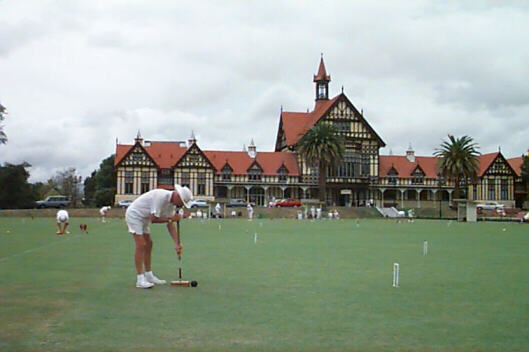
One surprise at the museum is that they had the same lax standards of dress as the rest of New Zealand. Seems almost one person in five doesn’t even wear shoes. There were several museum patrons wandering around the exhibit nearly naked. Their attire seemed entirely appropriate in the exhibit entitled “taking the cure”. There the Rotoruans chronicle the history of the healing power of the sulfurous steamy waters that run from the ground everywhere. The museum is housed in the old bathhouse for the community and for the exhibit they restored a few of the rooms and pools. Andy’s favorite part of the exhibit was the photo of the famed electric bath. We both pondered how fabulous and tingly that would feel, eesh!

After lunch we’d planned to go to the Maori Village and Geothermal park. We started to wait for the shuttle bus, but took a taxi instead. Our well-traveled driver had spent four weeks in the States last summer. There she’d seen more of it than I ever had, travelling in a van with seven other Kiwis. She also gave us some insight into the problems brewing at the tourist attraction we were about to visit. We’d been tipped off that there was some issue there by a seventy-year-old’s letter to the editor in the paper the day before. He’d complained that he had to pay two entry fees to see the sights he’d paid only once to see before. The government had refused to “cut” the Maori village in on the entry fees so the villagers barricaded the entry and set up their own tourist trap. Against our Maori driver’s recommendation, we decided on the government-run Geothermal Park and Cultural Center. There we knew we’d be treated to geysers, steaming pools, boiling mud puddles and a kiwi bird. Between the noise of the park and the smell it was truly the only place on earth you could be flatulent without anyone being the wiser.

All of this tourism in one day, but don’t stop reading yet, because that evening we also attended a Maori version of a luau. We almost bailed on it because the bus that was to pick us up seemed to have forgotten us and when we called they had lost our reservation. The desk clerk at our hotel convinced us that it was worth seeing, so we ordered a beer at the bar while waiting for our ride. Shirley the bus driver came just as we had taken our first sip, she made an immediate bad impression on me when she asked that we pour them out before getting on her bus.

After we made a stop at the office of the tour company to pay for our cultural experience an older Maori dude boarded the bus and began to brief us on the cultural protocol of the event to come. He selected a leader for our group, a reluctant dude named Ron. I listened intently waiting for the explanation of how and why the Maoris greet one another by rubbing noses. Vastly disillusioned when I learned that only our leader would get to try out the nose rubbing with the leaders of the host Maoris.

At our arrival we were greeted by an angry Maori who strutted, cried and made faces at us. His macho display was somehow diluted by the fact that he was a raging queen. Once we negotiated a truce with our hosts they invited us into their meetinghouse where they sang, danced and educated us before taking us to the holy mess tent. There we were served the most vile meal that had been steamed in the massive Maori outdoor oven, called a hangi. Dinner’s cast of characters included a brooding Israeli, a Brit and four trailer trash Americans. One named Lucky could barely speak he seemed so drunk.

We finally made our way home in the bus through the rain while Shirley led us in a multi-national sing-along. Every imaginable bus song was wailed by all. Lucky made us sing “Rocky Mountain High,” in tribute to the recently dead John Denver. I longed to be finished with tourism and back on my bike.

6

Rotorua to Taupo

Fred's better side while changing a derailleur cable
Fred’s better side while changing a derailleur cable

Dispelling any doubts that we were on the tourist trail, European hitchhikers lined the road out of town, holding signs marked “Taupo” and looking rather pathetic in the drizzle. Yet again I found myself happy having a bike to move me and my stuff around. The morning’s riding was hardly ideal, though: busy SH5 led us up a gradual, interminable incline through monotonous industrial forest.

At Waiotapu we turned onto a side road passing through an area rich in geothermal activity. We biked right up to what was the best bubbling mud pool either of us has seen, marveling that this attraction was available to us free of charge. Not so for the “painted valley” down the road a piece, where we rubbed shoulders once again with the ubiquitous bus tourists. We gave the attraction a skip, but stopped for a nasty lunch of meat pies.

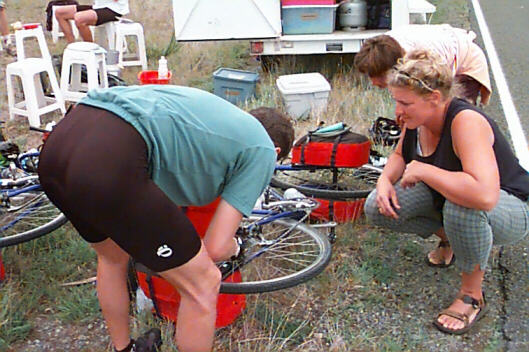
When Fred got back on his bike, he realized his rear derailleur cable was broken, which basically transformed his 24-speed machine into a 3-speed Dutch cruiser suitable for a leisurely pedal along the canals. Luckily, the terrain ahead was relatively gentle. Our route plunged down into a vast agricultural valley framed by volcanic ridges on either side, with Mt. Tauhara looming in the distance. I kept reassuring Fred that we weren’t too far from the town, and that we’d most likely be able to find a new cable for him there. In the meantime, he strained in his pedals behind my wind block. Just as we had resigned ourselves to a plodding pace into Taupo against the wind, an apparition emerged out of the drizzle: a panel van full of bicycle parts stopped by the lonely roadside. Had breathing all the sulfur fumes affected our brains?

It turned out to be a group of Dutch cyclists on a package tour, eating a lunch prepared for them by their amazingly equipped organizers. In typical Dutch, no-nonsense style, a woman named Helene sold Fred a new cable for something like four NZ dollars—next to a sheep pasture, miles from the nearest town.

As Fred and Helene fixed his bike, the Dutch cyclists bid us farewell one by one until only one remained, a guy who told us to call him Ray. Since he was on his own, we proposed that he ride along with us to Taupo—a fatal error, it turns out.

Ray proved to be an able rider, happy with our often sluggish pace (especially uphill), yet oddly taciturn. He rode behind us most of the way, never addressing a word to us. I kept forgetting he was there as we cruised through pastureland punctuated with forests of pine and steaming lakes of milky blue and green. Nearing Taupo, we elected to take a detour to check out a few tourist objects on our way into town: the Aratiata Rapids, the Huka Falls, and yet another geothermal area known evocatively as “Craters of the Moon.”

Huka Falls near Lake Taupo

It was at the first of these attractions that disaster struck. Atop the dam that controls the rapids, I stopped, Ray stopped, and Fred didn’t. At first I didn’t know what had happened, beyond Fred and Ray hugging the road. Both of them were pretty badly scraped up, especially Ray, who appeared to be in somewhat of a state of shock. We flagged down the first car to come along. The driver had an American accent, and while he was headed in the other direction, he offered to give Ray a lift into town, where his compatriots had set up camp. For the rest of the day, Fred and I kept looking at each other, feeling terrible to have played a part in what is sure to be the low point of Ray’s cycling holiday. By far the worst accident we’ve been a part of this trip, the event sobered us up a bit to the dangers of the road, and I hope we’ll continue with an intensified sense of caution…

As if to mock the darkness of our mood, the sun had come out at this point, shining on some of the most fetching scenery we’ve seen in this country. Everything looked green and lush, and the sound of the beautiful blue Waikato river filled the ionized air. We gave the rest of the tourist stops a skip in the interest of attending to Fred’s wounds, yet I couldn’t help but being beguiled by our first view of Lake Taupo—NZ’s largest—and the series of volcanic peaks towering on its far shore.

Taupo is a charming little place, full of tourists yet far less commercialized than Rotorua. In the hot pool of our cheesy Canadian-run motel I chatted with a trio of Kiwi tourists (two of them Dutch immigrants living here for forty years) who clued me in on certain aspects of NZ which have remained elusive to me. According to the formerly Dutch gentleman from Gisbourne, employers are hesitant to employ Maoris not because they are racist but because it involves a commitment to the employee’s entire family and tribe. If someone in the family (close or extended) dies, for example, the boss is expected to attend a funeral that can last up to five days. I also quizzed them on their opinions regarding the Prime Minister’s proposed Code of Social Responsibility, which passes into law such moral notions as “raising a child is the responsibility of its family.” All three dismissed PM Jenny’s ideas as “nonsense.”

At dinner we ran into our mysterious American from this afternoon, the guy who drove Ray into town. A fit-looking and self-possessed man in his forties, he introduced himself as Robin and offered to share with us the bottle of wine he’d brought with him. He told us of his solo travels around NZ by car and boat as well as his forays into the worlds of wine and Steadycam operation. He left quite an impression on both of us, a sort of traveling Buddha, completely free of stress or negativity. In retrospect, I should have asked him about my most pressing worry as we prepare to turn in tonight: what can we do to improve our karma that was so suddenly messed up on the dam today?

7

Taupo to Whakapapa

Calling the cops and displaying the damage

A gray day greeted us through the massive sliding glass doors of our room. Lake Taupo’s reflection of the dismal sky left it looking like a great disk of diamond-plate steel. My mood was in tune with the weather. I couldn’t help but think our luck had run out on us after the event of the day before. My perceptions seemed to come true as we rode through the drizzle along the lake and cars whooshed by us.

Fortunately the cloudy sky began to dissolve, sun cracking through the breaking clouds. Just as we began to be bathed in the sunlight we came across a rather large sow which we goaded into posing for our camera with a granola bar. What I’d anticipated as a calm and easy morning became a little more challenging as we ascended to the tops of the cliffs surrounding Lake Taupo climbing some 200 meters in two kilometers or so. Riding along the top we were afforded views of the massive lake formed by a collapsed volcano millions of years before.

In the exhilaration of our descent I began to forget the way the day began as we reached terminal velocity down the other side. Circumstance soon reminded me of my earlier sentiments when a pack of soccer fans started driving by us. They all had the “stars and bars” of the confederate flag draped in their rear windows and jeered at us as they passed. I nearly leapt off my bike when one used an amplified megaphone as they passed me. I felt a solid hit to my kidneys as one zoomed by. Couldn’t figure what had hit me, but it felt like a softball with its speed.

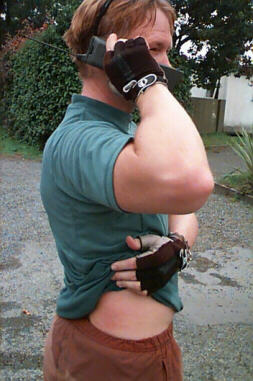
Until that point I hadn’t thought of Andy who was trailing behind me by a few hundred yards. I became worried about what indignities and assaults he had suffered at their hands and stopped to find out. He’d been hit by something too; it had left a welt on his back and exploded on impact. We stopped at a little market and a deliveryman made a call to the police on our behalf.

Above Lake Taupo
Above Lake Taupo, only 1000 meters more to climb

The route from there was stupendously lovely and narrow road that wound along the rocky lip of the lake. It was hard to concentrate on the beauty of the ride with huge double trailer lorries passing so closely to us along with the fresh memory of our recent attack as distractions. I found myself flinching as each vehicle passed. Stopping at a campground for a snack we exchanged stories with the owner, who told us she’d run the young rebel hooligans off her parking lot a few moments before. She called ahead to the police and added to our complaint. The police told her that they’d stopped the car and hoped we’d stop in at the police station at the next town to make a report. I found some elation in the fact that they’d been at least stopped. Perhaps scared about the consequences of their actions. Even so another vehicle with the flag passed, this time throwing water balloons at us, renewing my flinching reflex.

Our experience at the police station left me in no way assured that there would be any consequence to our report. The desk officer gave me no confidence that there would be any follow-up. Surely no one would ever be able to comprehend the report he wrote before us; every other word contained a grave misspelling. Afterwards we downed a fast food lunch and were on our way. Our route following lunch could take us two different ways. One via a quiet road up six kilometers sharply to over one thousand meters. The other over a busy road though more gradual. I lobbied for the quiet one; we could simply “take our medicine” and do the climbing more quickly. I am not sure if this was the smarter decision, for the climb reduced my legs to wobbly rubbery appendages and we still had some 45 kilometers to make our final destination.

The name Whakapapa presented some problems in and of itself. First, in the Maori language the sound “wh” is pronounced as an aspirate “f”. Second, an “a” following this consonant is pronounced “uh”. Making the name of the town sound obscene if you dared to pronounce it correctly. We were in a “no-win” situation, if we dared pronounce it correctly the locals blushed and looked at us as though we were being presumptuous. Pronouncing the name as we would in English yielded a quick correction. More often I allow myself the luxury of pronouncing everything wrong and giving the Kiwis the pleasure of correcting me.

The hotel itself was Andy’s favorite type. Sporting a faded grandeur and vacant feel that evoked the same spine chilling effect you’d get from watching “The Shining” late at night in an empty house. Before dining in the massive formal dining room we played a game of pool on a table so large I felt like Alice in Wonderland. It had special long cues and bridges in order to use it. Without exaggeration, it was at least 3 meters by six meters, perhaps larger, and the balls were less than regulation size—making our game all the more challenging.

At dinner I nearly fell asleep at the table. My belly was full and my legs were aching. It had been many months since I’d ascended over 1300 meters and ridden over 100 kilometers in a day.

8

Whakapapa to Ohakune

Gordon and Carol in the rain

We woke up to find ourselves ensconced in a thick misty cloud—which did not bode well for the day of hiking we had planned. We decided to postpone any decision as to what we’d do with our day until after breakfast, however. Downstairs in the dining room, the same tape we had heard last night was playing—classical music’s greatest hits—and this influenced our decision to ride. Charming as the once-elegant Grand Chateau hotel was, did we really want to be trapped up here another night, inside of a cloud, listening to Pavarotti sing “Nessun Dorma”?

Within what seemed like minutes, we were flying down the long hill towards a crossroads called National Park. Rather than abating in lower altitude, the mist grew worse here, occasionally thickening into something classifiable as genuine rain. It was a nice change of pace to be whooshing downhill, though, so I didn’t mind a bit.

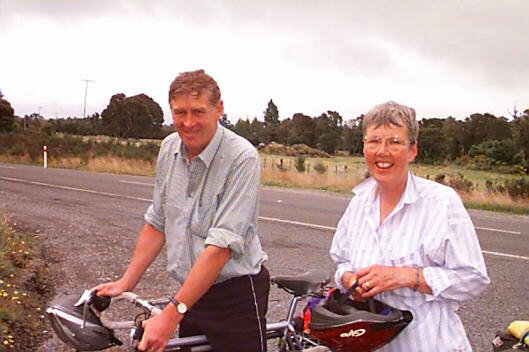
Climbing out of a deeply cut gorge, we caught up with a pair of our cyclist brethren, Cathy and Gordon from northern England. We stopped to talk to the older couple by the roadside under the intermittent drizzle, and were struck by their gumption. Pressing on to our goal—where we knew we could catch a train to Wellington in time for Saturday night—we raced down a long, almost imperceptible descent, with what must have been a pretty strong tailwind. After half an hour of this pedaling bliss, we turned off to the left into gorgeous sheep-filled scenery at the foot of the North Island’s tallest mountain (shrouded in clouds).

Ohakune's Giant (and dark) Carrot
Ohakune’s Giant (and dark) Carrot

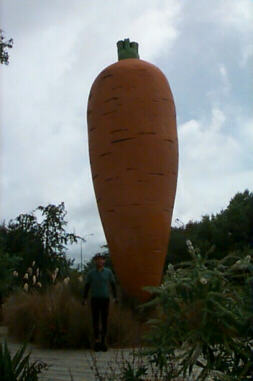
Ohakune surprised us by being easily the most charming country town we’d passed through in this country. It had a frontier, old-West look and feel to it. We stopped at Visitor Information to get the dope on the train and learned that Ohakune’s landmark, a giant plaster carrot, lay just down the road. I insisted we bike there for a photo before lunch in a trendy café, where we ate bagels and ran into Gordon and Cathy once again. They were done cycling for the day, and we envied them staying in such a beautiful place. Fred proposed several times that we do the same, but since the train didn’t run the next day (NZ basically shuts down on Sundays), we thought it best to stick with plan A—or was it plan B?

The train station was a ways out of town and absolutely deserted. We were the only passengers to get on or off when the dinky rattling old iron horse hissed to a stop. An officious woman told us we’d have to take our bags off our bikes before loading them, then recanted when we said we’d lift them up ourselves. The same woman sold us our tickets, served us tea and provided a running commentary throughout the bumpy 5-hour journey. For all we knew she was driving the train, too.

9

Wellington

The day before had destroyed me. Every bone in my body had ached, so I felt no shame in arriving to Wellington by train. We did feel some shame and panic when we realized that every accommodation in the entire town was booked. Except for the kindness of a woman at the train station we’d have never found a place to stay. As it was we ended up out by the airport the first day.

We managed a place in the center of Wellington the next day. There we developed a feel for the city, which is decidedly quirky. It felt as though a weird little city like Santa Cruz, California, with all of its hippies and odd-balls, had been declared a capital. Complicating matters, the International Dragon Boat Competition was being held alongside the National Maori Cultural Festival.

The amazing tourist attraction of Wellington is their new national showcase museum, Te Papa. It is truly the “papa” of all museums. Its edifice is like an airport terminal in stature, floating out by the harbor, its massive halls filled with geologic, historic, cultural, natural and technologic exhibits. Perhaps one of the more amazing museums I’ve ever seen. Like the town of Wellington, many of the exhibits were quirky and strangely curated. My favorite was the sheep and wool exhibit that explored the history and uses of sheep in New Zealand.

One of the best bargains of the trip, after the free trip to Te Papa was the repair of my damaged bag. When the Dutchman and I collided it tore the buckle off one of my front panniers. It cost only $3.50 for the buckle and sewing it on.

10

Wellington/Picton to Hauwai

NZ traffic jam
NZ traffic jam

I don’t think I knew what wind was until today. From the moment I woke up and peered out the filthy, rain-spattered window of my little cell, I knew it wouldn’t be an optimal riding day. But the rain was only a secondary problem, or so I realized during the ride to the boat harbor, which was way too fast and way too easy—meaning that the wind was coming out of the south, the direction we’d be heading the rest of the day.

The scenery between Wellington and Picton is said to be gorgeous. We didn’t see any of it, though. Fog and rain had swallowed up all the views, and it was way too cold to go out on deck. So we spent the three-hour voyage gabbing with an adventurous German cyclist called Stefan and an angelically beautiful young Dane called Finn.

It was raining pretty hard when we disembarked in Picton, but we decided to do the butch thing and ride. It was tough going at first, up a big hill that led out of town, against the wind and under the rain. But after a while the rain subsided and the road led through a steep-sided canyon that cut off most of the wind. When we arrived in the town of Blenheim—where we thought we’d spend the night—the sun was shining, tempting us to continue, wind or not. At tourist information, we booked bed-and-breakfast-and-dinner on a farm some forty kilometers further down the road.

Pete helping us cheat

We figured we’d make it there in two hours, three hours tops, but it took closer to four. The wind had picked up considerably and was coming right at us. All our concentration was focused on simply keeping our bikes on the road, and proceeding towards our goal, one revolution of the pedals at a time. Pretty as the scenery was—especially through two rather high passes—the riding was hell. The wind was so loud I literally couldn’t hear myself think.

Just as I was contemplating crawling into a ditch and quietly dying, a car pulled up to us and stopped. The pumpkin-shaped driver leapt out and asked if we were two tired Yanks. It was Pete, our host for the night, and he was offering us a ride the final couple of km back to his place. On the way, he pointed out NZ’s only salt works and the site of the new port, which he saw as his winning lottery ticket. He told us that when the Wellington boat arrives literally at his front door, he’ll have a houseful of guests every night. In spite of his optimism, Fred and I noticed no work underway to make this new port a reality. Pete may very well have a long wait ahead of him. And in the meantime, he’ll be working in the salt mine in order to make ends meet. Tomorrow is the first day in thirty-five years that he’ll be working for someone else.

Pete’s house is pleasantly situated in a little glade at the base of some hills and was therefore protected from the screaming gale. He introduced us to his “housekeeper” Joy. “I give her free room and board in exchange for housework,” he explained with some embarrassment, causing us to wonder if he wasn’t telling the whole story.

“We’re having seafood soup and steaks for tea,” announced Pete. Did this mean we’d be having scones and crumpets for dinner? When I announced my intention to go out and have a look at his sheep (15/16 purebred Fresians, which he keeps for stud purposes), Pete made a rather off-color joke involving gumboots. And during the newscast we all watched together, chomping away at the delicious meal, our opinionated host maintained a running commentary. Overall, a hilarious evening. And one which came to an abrupt end. Country people turn in early, it appears, which suits us fine in our wind-blown state.

11

Hauwai to Kaikoura

Road to Kaikoura
Road to Kaikoura

In the predawn darkness I was shaken from my bed. At first I’d assumed that it was merely the first train of the day passing by Pete’s farm, but the rattling was too intense. Luckily I was sleeping in the part of the farmhouse that rested on a cement slab, unlike Andy and the others, who rode the quake atop the pilings that made the foundation in the back part of the house. Andy darted about the house excitedly, admitting that it was his first major earthquake. It measured 5.8 on the Richter scale; even so we all somehow made it back to sleep, except for Pete. Today would be his first day working at the salt marsh down the road. Before the quake he had some trepidation about starting the new job; he’d not worked for someone else for over 35 years. I couldn’t help but wonder if he thought Mother Nature’s demonstration a bad omen.

I was worried about something different this morning, curious if we’d have to fight the vicious winds of the day before again. Thankfully as we set off down Pete and Joy’s gravel driveway the sky was clear and the breeze non-existent.

The first part of the day reminded me of the coastal hills of California. Brown drought-dry grass covered the rolling hills where sheep grazed instead of cows amongst the occasional trees. Soon we rolled down to the coast where the road hugged the craggy coast. Denser greener foliage carpeted the volcano-formed slopes of the snow-capped mountains above us. We stopped to talk to a pair of German cyclists who were decidedly antisocial and went on our way. Stopping only to photograph sea lions nursing their pups and basking in the warm sun on the rocks, we pedaled on to Kaikoura.

The view from our room at the Panorama

Our motel in Kaikoura, the aptly named Panorama, gave us a startlingly beautiful view of the bay and the mountains beyond. Pushing up the sea bottom’s limestone formations formed the coastal lands. Squiggly white layers of rock make fantastically intricate seascapes, where we found birds nesting and seals resting during our evening walk. Hiking up the cliff, we walked amongst sheep grazing in the golden sunset and I thought that a sheep’s life might not be so bad here.

On our way back to the Panorama we stumbled upon a little café that served us a world class meal. There we met Belgian and Iranian couples, shared a bottle of wine and reveled in what a perfect day this had been. What a contrast to the day before!

12

Kaikoura to Cheviot

Before and after shearing

The frantic pace of the NZ segment of our tour caught up with me this morning. Motivating myself to get out of bed was harder than usual, even with two cups of coffee (thoughtfully provided by my considerate riding partner) under my belt. Just as we were discussing our breakfast options, our Arizonan-Iranian neighbor, Mike, came by and asked us if we wanted some cereal, thus saving us a stop and getting us on the road at the bright and early hour of 10:30.

The first 20-odd kilometers of the day took us along more beautiful coastline, with more seals and huge colonies of sea birds. Then the road turned abruptly inland and up into a series of steep but beautiful passes. We panted and strained our way up a slope, only to drop down again and recommence climbing. On the plus side, the scenery here was stunning.

Once we’d descended again, the ride became much easier, following river valleys past endless fields of sheep. Some of these beasts looked different from what we’ve grown accustomed to seeing. Having been freshly shorn, they had a pinkish hue, resembling baby mice. Passing one barn, I heard a telltale buzzing sound, and instructed Fred to stop. We thought we could sneak inside and get a photo or two of the sheep-shearing, but the gate to the farm was firmly closed. The stop wasn’t a total washout, however. As we sat waiting for shaved sheep to emerge from a hole in the barn and into a holding pen, Masa rode by. We’d met him on the boat from Wellington, a cute young Japanese from Kobe with an extremely limited vocabulary in English but a million-dollar smile. We invited him to ride with us the last hilly 10km to Cheviot, where we had a beer in the first bar we came across. The place was packed with oldsters, many of whom came up to talk to us. One woman with a heavy Scottish brogue said she’d seen us from the bus earlier and was afraid we’d get “burrrnt.” I made her repeat this last word four times before I understood her, and assured her that we were well-coated in sunscreen.

Scots of Christchurch terrorize the countryside

We went in search of a motel (for us) and campsite (for Masa) and were very fortunate to find them both in one complex, an adorable, out-of-the-way place run by a friendly Dutch couple. As Masa set up his tent, we took a dip in the frigid, scum-surfaced pool. On our way out to buy groceries, we saw another cyclist checking in and recognized him as Earl, a 71-year old from Nebraska who had also been on our boat from Wellington. We decided to invite them both to dinner at our place and bought the makings for a feast in tiny Cheviot’s only grocery store.

Before dinner we still had time for a yoga session in a secluded lawn next to a field full of woolly baah-ing sheep. It felt fantastic to give our sore muscles a proper stretching.

It was amusing to host a dinner party in the middle of nowhere to a couple of cycling strangers. Loquacious Earl told us how he’d flown to NZ for free aboard an Army plane, and how this was his first trip abroad. Everyone back home in his small Nebraska town thought he was nuts, but he had been determined to cycle New Zealand for a long time. We swapped road stories and found his complaints (sadistic truck drivers) to match ours exactly. Meantime, Masa smiled and shoveled alarming quantities of pasta into his face. Both our guests said they were going to get an early start the next morning. Fred looked at me hopefully and I shook my head. No way was I going to be part of a 120-km race to Christchurch, where Masa had a rendezvous with his girlfriend at three o’clock. “Maybe we’ll see you on the road,” I said to Earl and Masa as they retreated to their respective tents.

13

Cheviot to Christchurch

Samurai Cyclist
Samurai Cyclist

Both Earl and Masa were well along their way by the time we finally rolled out of the Cheviot Motel at 9:30 a.m. The first kilometers of gently rolling brown and grassy hills passed by easily though we were ascending to make a pass into the Hurunui Valley. We made our way up the valley cursing the inaccuracy of our guide book which declared the route without noticeable hills until the pass into the Greta Valley. Time after time we dipped into the river valley and pedaled our way out.

Finally we reached the top of the valley and stopped at a gas station for a quick roadside meal of chips and drinks, our bodies begging for the replenishment of salts. Descending was not the picnic we’d anticipated. The wind had taken a turn and we were now having to pump our way down the hill and were only traveling at 15km/h. With each turn of the crank the temperature rose, the road became more truck trafficked and we fatigued. As we hit kilometer 70 we arrived in Amberly, where we ran into Earl, who had just arrived though he’d left two hours before us.

I’d grown tired of trucks passing too closely to us as they passed and lobbied Andrew for taking a bus the last kilometers to Christchurch. He readily agreed and we found a helpful woman at the tourist information office to give us advice on getting there. While helping us she renewed drivers’ licenses, answered phones and did her nails. She was a tornado in action. “Just make your way to the ‘Tank and Tummy’ across the way and you can pick up a bus there,” hustling us out the door so she could get onto solving the Gulf Crisis for Kofi Annan.

Computin' in Ch-Ch
Computin’ in Ch-Ch

From the faithful T & T we had a snack while waiting for our bus. It buzzed by us though we were waving frantically and we were ready to ride on to Christchurch on our own. At the last minute the driver hit the brakes, stopped and put our bikes in the massive luggage compartment at the back, bags and all. Within minutes I was napping and we were on our way to the end of the line for us in New Zealand.

We found our way to the YMCA and ran into Masa and Kiko there. Masa was searching for a campground in Christchurch without any success. The town itself was not very cosmopolitan. A hot night there involves driving around the block revving your motor and trying to run down pedestrians while hooting and hollering at chicks. We opted to see the cinematic classic “Starship Troopers” and went out for a drink.

We managed to avoid the star attraction of town, climbing up the church tower. It was maybe 30 meters high and all we could imagine seeing from up there is a view of all the ugly ’50s, ’60s and ’70s architecture that had polluted the Christchurch building stock. We could hardly see the advantage of hiking up it especially knowing that earthquakes had toppled the tower at least twice since its original construction. Of interest is the City Museum and Gardens. The museum sports a fantastic exhibit on Antarctic exploration as well as more stuffed fauna than you can shake a stick at, displayed in really well done dioramas.

Departure from Christchurch (or ch-ch as the locals abbreviate it) was more difficult than anticipated. No bike boxes were available at the airport so the logistical nightmare of getting the boxed bikes to the airport lay before us. A crammed-to-the-gills airport shuttle got us there after stopping at every hotel in town before taking us to the bike shop to pick up the bikes. We endured the sneers of the other passengers while we dealt with the marginally competent staff at the shop.

I had the excited feeling we were going on to a new adventure when we finally got into the air. Thankfully we’d be arriving the day after the madness that is Sydney’s signature gay event of the year, The Gay and Lesbian Mardi Gras.

New Zealand Photo Essay

View all 22 photos →