
Grossenbrode, Germany to Vordingborg / Copenhagen
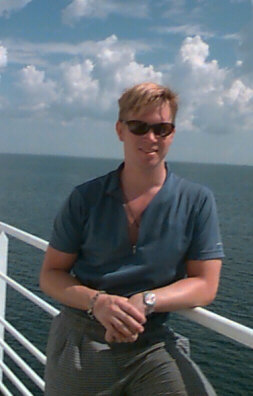
Almost in Denmark
How excellent it felt to be on my way to Denmark, aboard an overcrowded boat full of duty-free shoppers and a segmented train on its way from Paris. The ride from Grossenbrode to Puttgarden was painless, and the big puffy clouds looked like a Turner painting. Plus there was the added satisfaction of arriving in a Danish port called Rodbyhavn, which is written with a line through the “O.” I had made it to Northern Europe, and would soon be seeing my friends Niels, Eva and Freddy in Copenhagen. The only other cyclists who had boarded with me were a trio of beefy German lads. When I remarked upon their lack of gear, they explained that they were only going to the beach for the day. “But aren’t there beaches just as good on the German side?” I asked. “Yes, but there aren’t any Danish girls on them,” the most oafish of the three stated lasciviously, practically licking his chops, nearly causing me to gag. Yes, I thought, as superlative as yesterday’s riding had been, I was happy to be leaving the Bundesrepublik.
My first impressions of Scandinavia –which I have always considered the pinnacle of the civilized world— weren’t overwhelmingly favorable. Well-marked cycle tracks led me through mostly nondescript villages as I traversed the islands of Lolland, Falster and Masnede. Outside a café in Sakskobing (yes, with a line through the “o”), I saw a sign advertising coffee and kringle for fifteen crowns, and promptly decided to take the plunge. I was familiar with kringle from Racine, Wisconsin, where the sticky Danish pastry is lauded as this rustbelt city’s chief cultural contribution, emblematic of its connections to the Old Country. Aside from “tak,” “kringle” was the only Danish word I knew. I marched inside and ordered my coffee and kringle with confidence, amused by the boisterousness surrounding me. Every person in the place was hopelessly inebriated, even though it was only 2pm. I guess happy hour starts early in Denmark. I basked in the decidedly un-German ambiance as I sipped my coffee, wondering what could be taking so long with the kringle. More than once I asked the bartendress, “What about that kringle?” to which she smiled and said, “yes,” only to leave me and serve the next customer. Finally I had to resort to pointing to the sign, saying “kringle” with every possible inflection before she brought a piece out for me. I learned later from Niels that “kringle” does not rhyme with “shingle,” as I had been taught, but sounds more like “strangled.” I also learned that “cykyl” –meaning bike— is pronounced similarly to the English word “sugar.” This dispelled any further attempts to learn Danish on my part.
Niels also explained to me that Lolland is the “social disaster of Denmark,” with the country’s highest unemployment rate (not to mention the ugliest scenery). While it didn’t exactly look like Detroit, it’s true that the area didn’t meet my expectations of Danishness either. The houses and villages seemed devoid of character and the people didn’t seem to have that golden, privileged look I associate with Scandinavians. And the landscape didn’t come close to matching up with the skyscape, which was growing more dramatic by the minute. While crossing the very long bridge to Seeland (Denmark’s largest island, and home to Copenhagen), rain started pissing down on me. I had intended to make it all the way to Koge, essentially a suburb of Copenhagen, but a few miles out of Vordingborg I saw that the main road didn’t have a cycle path, and that bikes were rerouted along a much longer route. Normally, I wouldn’t have a problem with this, but I was expected in Copenhagen in 3½ hours, so I turned tail for Vordingborg’s train station.
The train wasn’t for another hour, prompting me to expose myself to yet another taste of Danish bar culture. The Amigo Bar was a much classier operation than the hole back on Lolland. Most customers were watching the Tour de France on a giant television, before the broadcast switched to outrageously dull live feed covering Air Force One leaving Copenhagen airport. Two jolly Danes playing a dice game called Chicago informed me that Clinton’s visit was the first by an American president in many decades, and that the whole country was consumed by Clinton fever. One of them told me how much he loved America and how sad he found it that our social system was such a mess. He told me how he had wept the day Kennedy died and gave me a big sentimental hug when I left to catch my train.
The train was full of other cyclists, as well of Danes of every ilk. Most of them had removed their shoes and were munching messily on snacks. Niels’ much espoused theory that Denmark is the Italy of Scandinavia appeared to be an astute one. All the passengers were chatting loudly and behaving as if they were in their living rooms at home. I was surprised when the couple across from me produced a child from nowhere over an hour into the voyage. Apparently they had left her in the baggage car along with their bikes, which reminded me of the story of the Danish couple who had recently been arrested in New York for leaving their baby in his stroller on the sidewalk while they shopped. I didn’t mention this, though, hoping they’d help me unload my beast when we arrived in Copenhagen, and quietly delighting in the remarkably casual attitude with which the Danes appear to approach everything.
I found my way to Niels’ place without the aid of the map, having been there twice before. He lives in what he claims is “the gayest street in Copenhagen,” just above a bar, a sauna and a leather boutique. It felt great to be in familiar surroundings. Promptly I was whisked off to Thomas’ house, past the debris-strewn square where Clinton had made his speech only hours before. Thomas is slight and blond and interested in politics. Two remarkable sisters were there, too, who had spent a lot of time in America. The younger of the two, Trini, is a professional fencer –a fact which I found thrilling. It felt gloriously homey after so many days feeling alienated and alone. We munched on salmon and vegetables and talked about everything imaginable before trundling into a pair of taxis that took us to a place called PAN, Copenhagen’s principal gay disco. I ran into my friend Darren there almost instantly (he’s received a prestigious grant to write a book on the state of so-called “gay marriages” in Denmark, the lucky bastard), but I was too beat to hold an intelligent conversation or to enjoy myself in any other way, and was soon pleading Niels to take me back to his ranch. We had a full day ahead of us, after all.


