Limassol to Pafos
Siegfried und Roy at the amphitheater of Kourion
The sun was shining through our porthole and the sea was calm; it was as if we had entered a new galaxy. In a way, I suppose we had; during the night, we had rocked and rolled our way into the easternmost Mediterranean, cradle of the monotheistic religions and —perhaps because of this fact—one of the most politically messed-up areas on the face of the planet. Climbing out of my coffin-like upper bunk, I felt a little twinge of uncertainty creep up my spine. In just a few hours, we’d be in Cyprus, a place I’ve always associated with car bombs, snipers, militarism and ethnic mayhem.
We didn’t arrive in port until past two, some three hours behind schedule due to last night’s weather. Eric and Anne, a British couple we had met at dinner, pointed out the island’s main geographical features as we cruised by them. They had been here before and gave us sound advice, though all I could think about were the hills we would be climbing, since the whole of the island looked pretty mountainous to me. John was on deck, too, as were a seemingly growing band of hippies of indeterminate origin, who provided entertainment with a frenzy of singing, dancing and yogic chanting. When we were actually able to hear each other over all the noise, we learned that John —plump, balding and definitely eccentric— was an air traffic controller in Fairbanks, Alaska. He planned to spend only two days in Cyprus, which he figured was enough time to check out the Green Line. He also provided us with some rather hair-raising tales of airplanes nearly crashing into each other.
Even though the seas were calm today, the disembarkation process was just as chaotic as it had been in Rhodes. The disorganized crew screamed out conflicting commands, the immigration officer on the gangplank appeared to have little grasp of his duties, and every car and truck wanted to be the first off the boat. No doubt about it: we had left the civilized world far behind us.
The first real sign that we were in a new place, though, was that the traffic was driving on the left. Neither of us was aware of this detail at first, and we nearly headed straight into a line of honking cars when we turned out of the entrance to the port. The center of town was several nerve-racking kilometers away. In a matter of minutes Cypriot drivers had earned the BikeBrats title for Worst Drivers in the World. More than once I had to brake hard in order to avoid colliding with a car turning left in front of me. It was if we were completely invisible to them.
The search for a place to stay entailed more than the usual hassle, too. While plenty of hotels lined the seaside promenade in the center of town, none of them seemed to want to deal with our bikes. “Outside” was the universal response as to where we could leave them, even in divey places with balconies large enough to accommodate a tank. Finally we resigned ourselves to this fact and checked into a place that gave us a good deal on a two-room suite which featured plenty of yoga room and a telephone that Fred thought would be easy to hook up to. We hadn’t been able to collect our e-mail in over two weeks, and it came as a happy surprise when we heard the modem connect for a change. This fact caused us to reserve judgment on Cyprus, tempted as we were to write off the whole place as a barbaric hellhole.
After a nap, a mediocre meal and a highly beneficial yoga session, we readied ourselves to hit the town. The first queer bar we found was right near our hotel, and it seemed very happening for being in a country where homosexuality was until very recently treated as a crime. Even the “intent to commit a homosexual act” (e.g. propositioning someone) was a prisonable offense, carrying a sentence of three to five years. The place was enormous, with high ceilings and as tasteful a decor as one is likely to find on Cyprus, and filled with a boisterous, mixed crowd. Recognizing us as outsiders, Stellios, the friendly owner, latched on to us immediately. He told us how he had lived in Paris in the ‘60’s and had also spent lots of time in California. Fred and I wondered if he was related to Siegfried and Roy, since he seemed to ascribe to the same aesthetic. His compact body was encased in a little black ensemble, opened in front to reveal a large number of gold chains, and his enormous head was topped with a lacquered helmet of something resembling hair, framing an alarming face apparently constructed of overly stretched leather. And the snifter of cognac in his hand seemed fused on, part of his anatomy. I wondered if I’d ever be able to transform myself into such an extraordinary creature in my dotage, or if I’ll follow the more standard route of running a dusty antique or book shop full of cats, lounging around in a mumu and listening to recordings of Maria Callas.
Our host informed us that the drag show was about to begin, warning us not to expect much. I thought he was just being modest, but the spectacle which ensued was truly the worst I’ve ever witnessed —the kind of show where they ought to hand out shovels beforehand to allow you to dig yourself a hole to hide in. One performer in particular had perfected a sort of Brechtian drag routine, wherein he’d lip-synch maudlin Greek ballads while staggering around stage clutching a bottle of booze, his wig askew, his dress three sizes too small, and his gonads untucked. Another performer was a pioneer in the extremely dubious art of drag-striptease. Much more genuine entertainment was supplied by a boy sitting at the table in front of us, who told Fred in no uncertain terms not to look at him. Unable to restrain myself, I yelled into his ear, “Exactly what kind of loser are you, anyway?” Thankfully, he didn’t understand me; nor did he press any charges against Fred, who probably wouldn’t enjoy Cypriot jail.
Once the show was over (its only merit was its brevity), Fred got himself into yet another argument with a malodorous young chap called Nikos, who voiced disdain for the Turks and all things Turkish, while I hobnobbed with Nicolai the Russian, who had recently left a teaching career to pursue investment banking. (Ironically Nikos claimed that all Turks were dirty — F)
Very rarely do we stay out late on the eve of a riding day, but we knew that today would be a short one, at least in terms of mileage. Pafos is only 70 kilometers from Limassol on the map, yet it felt a lot longer.

Birthplace of Aphrodite
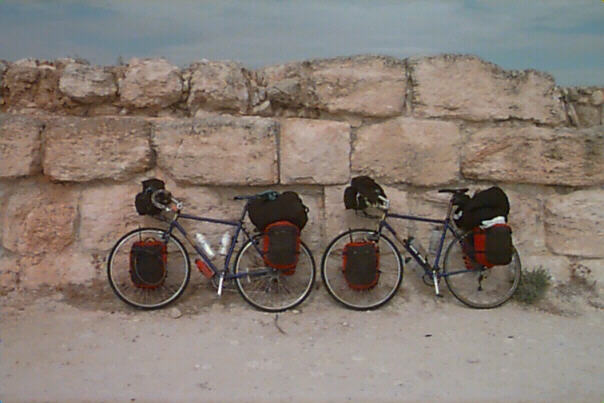
We set out just after lunch —a feta-free xoriatiki plus a lame excuse for a pizza—retracing our hazardous route to the port, and then beyond the city limits through a wonderfully level area of orchards and vineyards. The flat terrain didn’t last long, however. At the unremarkable archeological site of Kourion, the road made a sharp turn skywards. In a matter of minutes we were glistening with sweat and pumping along a high cliff with fantastic views of the azure sea below. Then our route plunged and dipped and climbed again through a very extensive British military base before dumping us abruptly onto the hell of the main highway, and the only road to Pafos.
It was one of those moments of existential crisis. We were climbing up the most brutal hill of the day, on a ridiculously narrow road, and the traffic was nothing short of horrendous. The steady caravan of shiny new sports utility vehicles gave us no room at all, whizzing by at speeds that can only be described as unsafe. “Why am I doing this?” I thought. “I really don’t want to be here; if only I had a home to go back to…” Later Fred told me he was experiencing a similar crise de foi. Then, as if in a dream, we heard a distinctly friendly honk among the roar, and saw a couple furiously waving at us. It was Eric and Anne, the Britannic couple from the Nissos Kypros, and they wanted to buy us a beer. (I was a little worried that timid and proper Eric and Anne had seen Andy flipping off nearly every motorist that passed — F) We must have looked a pretty miserable sight, slick with sweat and grime and utterly frazzled by the traffic. Of course beer was out of the question, since we needed all our concentration if we wanted to survive this road, but we did accept iced coffee.
I didn’t realize how much I needed the break until we stopped, high atop a mountain in a place called Pissouri. It felt fantastic to be off the road and conversing with civilized people. The several bags of potato chips were a big help, too, replacing all the salt we’d lost. At my insistence, Eric gave us a detailed hill- and traffic- profile of the road ahead, reassuring us that there were only a couple of more climbs. I hoped with every fiber of my being that it wasn’t just British understatement, but he turned out to be right. From our coffee stop we plunged back down to sea level, with only a couple more climbs, neither of which held a candle to Pissouri in terms of nastiness. An added bonus was the beauty of the coastline, which distracted me somewhat from the noise of the evil autos that continued to scream by.
At the alleged birthplace of Aphrodite we stopped for an ice cream and watched a foursome of vulgar, mafiaesque Russians cavort along the edge of the cliff. Nearing Pafos, the terrain evolved into something far more manageable, and a stiff wind at our backs had us there in no time, which was not a moment too soon.
Learning only yesterday that Cyprus is a big destination for Brits on package tours, I was completely unprepared for Pafos. I had included it on the itinerary in order to check out the supposedly famous mosaics here, not knowing that we’d be staying in the Las Vegas of Cyprus for the privilege. A seemingly endless strip of resort hotels lined the coastline into the center of town, where we scored an apartment in a complex normally reserved for down-market package tours. When we walked out in search of dinner, we found ourselves surrounded by a veritable sea of Britannic tourist swill: fish-and-chips stands, bars advertising cheap pints and live rugby coverage, tacky souvenir shops.
Luckily we had a guide in the person of John. We met him the night before in Limassol, and he gave us his number in Pafos, where he has lived as a refugee from Dutch weather for five years now. He took us out for drinks in a fairly skanky outdoor bar and told us with great enthusiasm all about his libidinous exploits. Claiming to be just over fifty years old but looking two decades older, he manages to feed from a veritable cornucopia of young Cypriot boys. His latest boyfriend, he lamented, resides with his parents and lives in constant fear of being “found out.” Even John displayed a certain amount of circumspection, refusing to accompany us to Pafos’s only “gay bar” on the grounds that “I wouldn’t want anyone to see me there.” Expecting a den of iniquity, we were bitterly disappointed by the bar —called “Different”—which appeared to be the watering hole of choice for local yuppies and glamourbabes. Everyone but us was all gussied up for Saturday night, and the flamboyant bartender/owner seemed to be the only other homo around. On the positive side, the bar’s total lack of appeal provided us with a good excuse to climb into our beds and read.
Our plan to ride up to the mountains the following day was frustrated by a string of thunderstorms and pounding rain. So we settled for a lazy day of poking around ruins and admiring the mosaics in our rainsuits, playing backgammon in cafes, gorging ourselves on a delicious Indian dinner, and not much else.